

What Does a Single Tooth Implant Actually Cost in 2026?
The price of one dental implant in 2026 typically falls between $3,000 and $6,500 for a complete restoration, including the titanium post, abutment, and crown.
Here’s a quick snapshot of what most patients pay:
| What You’re Getting | Typical Cost Range |
|---|---|
| Implant post (surgery only) | $1,500 – $2,500 |
| Abutment | $300 – $1,000 |
| Crown | $1,000 – $3,000 |
| Complete single tooth implant | $3,000 – $6,500 |
| National average (all-in) | ~$4,500 |
Bottom line: Budget for $3,000–$6,500 for a straightforward single tooth implant. Additional procedures like bone grafting or tooth extraction can push the total higher.
Those numbers can feel like a lot, especially when you’re already dealing with the stress of a missing tooth. But understanding exactly what drives that price helps you plan with confidence and avoid surprise bills.
This guide breaks down every cost involved, explains what your insurance will and won’t cover, and shows you how a single implant compares in value to cheaper alternatives over time.
I’m Dr. Thomas Jennings, DDS, MAGD, founder of Pinnacle Dentistry in Colorado Springs, and with over 35 years of restorative experience, including extensive post-graduate training in implant dentistry, I’ve helped hundreds of patients understand and plan for the price of one dental implant before they ever sit in the chair. Let’s walk through everything you need to know.
What is the Average Price of One Dental Implant in 2026?
When you begin searching for the price of one dental implant, you will quickly notice that “average” is a relative term. In May 2026, the national average for a single tooth replacement stands at approximately $4,500. However, this is a composite number. Some patients with high bone density and a simple extraction may find their costs closer to $3,000, while those requiring complex preparatory work might see quotes reaching $6,000 or more.
It is important to distinguish between the surgical cost of the post alone and the “all-in” price. Some national chains or high-volume clinics might advertise a “dental implant” for $1,500 to $2,000. Usually, this refers only to the titanium screw and the surgical placement. To get a functional tooth, you still need the abutment and the custom-made crown.
At Pinnacle Dentistry, we believe in transparency. How much do dental implants cost? is one of the most frequent questions we hear, and the answer always starts with a comprehensive evaluation. According to 2026 pricing data from sources like the single tooth implant cost: $4,500 avg in 2026 ($3,000–$6,000), the total investment reflects the high-quality materials and surgical precision required for a lifetime solution.
Regional Variations in the Price of One Dental Implant
Geography plays a significant role in what you will pay. While the national average gives us a benchmark, local market factors, such as the cost of living, office overhead, and regional demand, shift the needle.
In Colorado, and specifically here in Colorado Springs, prices tend to align closely with national benchmarks, though they can be slightly higher than in rural areas due to the specialized nature of the care available.
| Location | Estimated Single Implant Total (2026) |
|---|---|
| National Average | $4,500 |
| Colorado Average | $4,525 |
| Hawaii (Highest) | $5,238 |
| Alabama (Lowest) | $3,950 |
For those looking for colorado springs dental implants, you are investing in a region known for high clinical standards. While you might find lower prices in states like Mississippi or Alabama, the logistical costs and the value of having your surgeon nearby for follow-up care usually make local treatment the more sensible financial choice.
Understanding the Total Price of One Dental Implant
To avoid “sticker shock,” we always recommend asking for an all-inclusive quote. A transparent treatment plan should itemize every step of the journey. If a quote seems suspiciously low, check to see if it includes diagnostic imaging, the final restoration, or follow-up appointments.
Generally, the total cost is split into three main buckets:
- The Surgical Phase: Placement of the post and anesthesia.
- The Restoration Phase: The abutment and final crown.
- The Diagnostic Phase: 3D scans and surgical planning.
Breaking Down the Components of Single Tooth Implant Costs
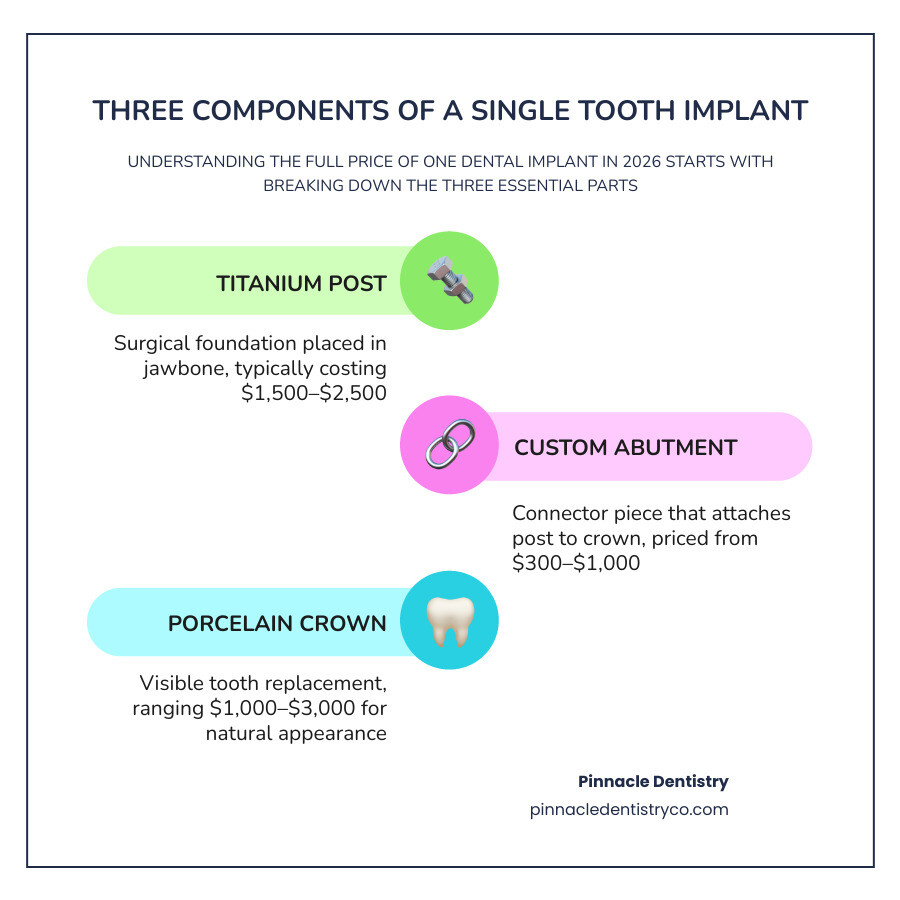
To understand the price of one dental implant, you have to look at it as a three-part engineering project. You aren’t just buying a “tooth”; you are buying a replacement root system.

- The Implant Post: This is the titanium or zirconia screw that acts as your new tooth root. It is biocompatible, meaning your bone will actually grow into it through a process called osseointegration.
- The Abutment: This is the connector piece. It screws into the implant post and sits just above the gum line, serving as the “stub” that holds your new tooth in place.
- The Crown: This is the part people see. It’s custom-shaded and shaped to match your surrounding teeth perfectly. These three pieces come together to restore much of the stability, function, and appearance of a natural tooth.
Diagnostic Imaging and Planning
Precision is the enemy of failure. In 2026, we don’t guess where an implant should go; we use 3D CBCT (Cone Beam Computed Tomography) scans to create a digital map of your jaw. This allows us to avoid nerves and sinuses with sub-millimeter accuracy.
While these scans typically add $200 to $600 to the initial diagnostic phase, they are essential for safety and long-term success. We emphasize the importance of 3d imaging for precise dental implants because it significantly reduces the risk of complications that could lead to much more expensive repairs later.
Preparatory Procedures and Hidden Fees
The “hidden” costs of dental implants usually aren’t hidden by the dentist, they are simply dependent on your unique biology. If you have been missing a tooth for a long time, your jawbone may have thinned out.
- Tooth Extractions: If the damaged tooth is still in place, it needs to be removed ($200–$700).
- Bone Grafting: If your bone is too thin to support the implant, we add bone material to strengthen the site ($500–$3,000).
- Sinus Lifts: For upper back teeth, we may need to gently lift the sinus membrane to make room for the implant.
Factors That Influence the Total Investment
Why does one person pay $3,500 while another pays $5,500? Beyond preparatory work, several factors influence the price of one dental implant.
Specialist vs. General Dentist Fees
Experience matters. While many general dentists perform implants, seeking care from a provider with advanced credentials can impact the price and the peace of mind. At Pinnacle Dentistry, we provide care through MAGD (Master of the Academy of General Dentistry) certified dentists. This is a distinction held by less than 2% of dentists in the U.S. and represents over 1,100 hours of continuing education.
When you are preparing for a dental implant procedure, you aren’t just paying for the hardware; you are paying for the surgeon’s ability to handle complex cases and ensure that the implant is safe, well-positioned, and designed to last.
Material Selection and Longevity
The quality of the titanium or zirconia used in the post and the porcelain used in the crown affects the price. “Value” implants exist, but premium, medical-grade titanium alloys offer superior strength and better osseointegration.
A high-quality implant is designed to be a “one and done” investment. While the crown may need replacement after 15–20 years due to normal wear, the dental implants lifespan for the post itself is often the rest of your life.
Insurance, Financing, and Out-of-Pocket Realities
The biggest hurdle for many patients is the initial cost. In 2026, more insurance companies are recognizing implants as a “standard of care” rather than a “cosmetic” luxury, but coverage is still far from 100%.
Maximizing Your Dental Coverage
Most dental benefits plans treat implants as a “Major” procedure, typically covering 50% of the cost. However, almost all plans have an annual maximum, usually between $1,500 and $2,500. This means that even with “good” insurance, you will likely hit your cap with a single implant.
One strategy we recommend is the “Use It or Lose It” approach. By using your benefits before the end of the calendar year, you can sometimes split the treatment across two benefit years. For example, you might have the surgery in December (using 2026 benefits) and the crown placed in March (using 2027 benefits).
Financing Options for Uncovered Costs
If you don’t have insurance, or if your plan falls short, there are still ways to make the price of one dental implant manageable.
- HSA/FSA: Using pre-tax dollars from a Health Savings Account or Flexible Spending Account can effectively save you 20–30% on the cost of treatment.
- CareCredit: This is a healthcare credit card that often offers 0% interest promotional periods, allowing you to break the cost into monthly payments.
- In-House Plans: We often work with patients who do not have dental benefits to find a financing solution that fits their budget.
Comparing Long-Term Value: Implants vs. Bridges and Dentures
It’s tempting to look at a dental bridge and think, “This is half the price of an implant.” While the initial cost of a bridge might be $2,500–$4,000, the long-term math tells a different story.
Maintenance and Replacement Cycles
A dental bridge requires grinding down the two healthy teeth next to the gap to serve as anchors. This compromises those teeth and makes them more susceptible to decay. Furthermore, bridges typically last only 7 to 15 years. Over a 30-year period, you might replace a bridge three times, whereas a single implant is likely to still be going strong.
When you consider the long-term lifespan of dental implants, the “per year” cost of an implant is often significantly lower than other restorative options.
Nutritional and Health Benefits
Beyond the money, there is a biological cost to not choosing an implant. When a tooth root is missing, the jawbone begins to resorb (shrink). This can lead to a “sunken” facial appearance over time.
Implants are the only solution that stimulates the bone, preserving your facial structure. They also restore nearly 100% of your chewing power, which has a direct impact on your nutrition, comfort, and confidence.
Frequently Asked Questions about Single Tooth Implants
Are dental implants painful during or after the procedure?
This is the number one concern for our patients. The truth is, most patients report that the procedure is less uncomfortable than a standard tooth extraction. We use local anesthesia to ensure you are completely numb, and for those with anxiety, we offer sedation options.
How long does the entire process take from start to finish?
The journey usually takes 4 to 9 months. The surgery itself is quick (about an hour), but we must wait for the bone to fuse to the implant (osseointegration). This healing phase typically takes 3 to 6 months. Once the implant is stable, we place the abutment and finally the crown.
What is the success rate of a single tooth implant?
Dental implants have a success rate of over 95% at the ten-year mark. With good oral hygiene and regular checkups at Pinnacle Dentistry, that success rate remains extremely high for decades.
Conclusion
The price of one dental implant in 2026 is an investment in your health, your confidence, and your long-term financial well-being. While the upfront cost of $3,000 to $6,500 can seem daunting, the benefits of bone preservation, natural function, and a lifetime lifespan make it the most cost-effective choice for tooth replacement.
At Pinnacle Dentistry, our MAGD-certified dentists are dedicated to providing personalized, high-quality care in Colorado Springs. We don’t just place implants; we restore smiles and improve lives with a commitment to clinical excellence.
Ready to find out exactly what your path to a new smile looks like? Request an appointment today for a consultation at our Colorado Springs office. Let us help you navigate the costs and care involved in dental implants so you can smile with confidence again.
