
What Is the Sinus Lift Implant Procedure?
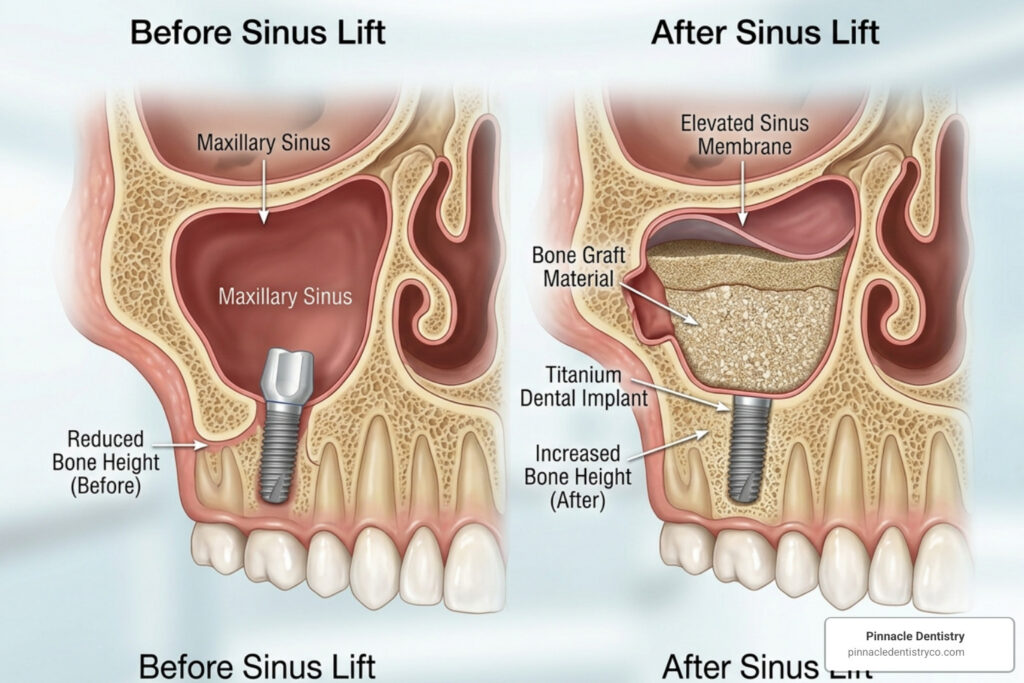
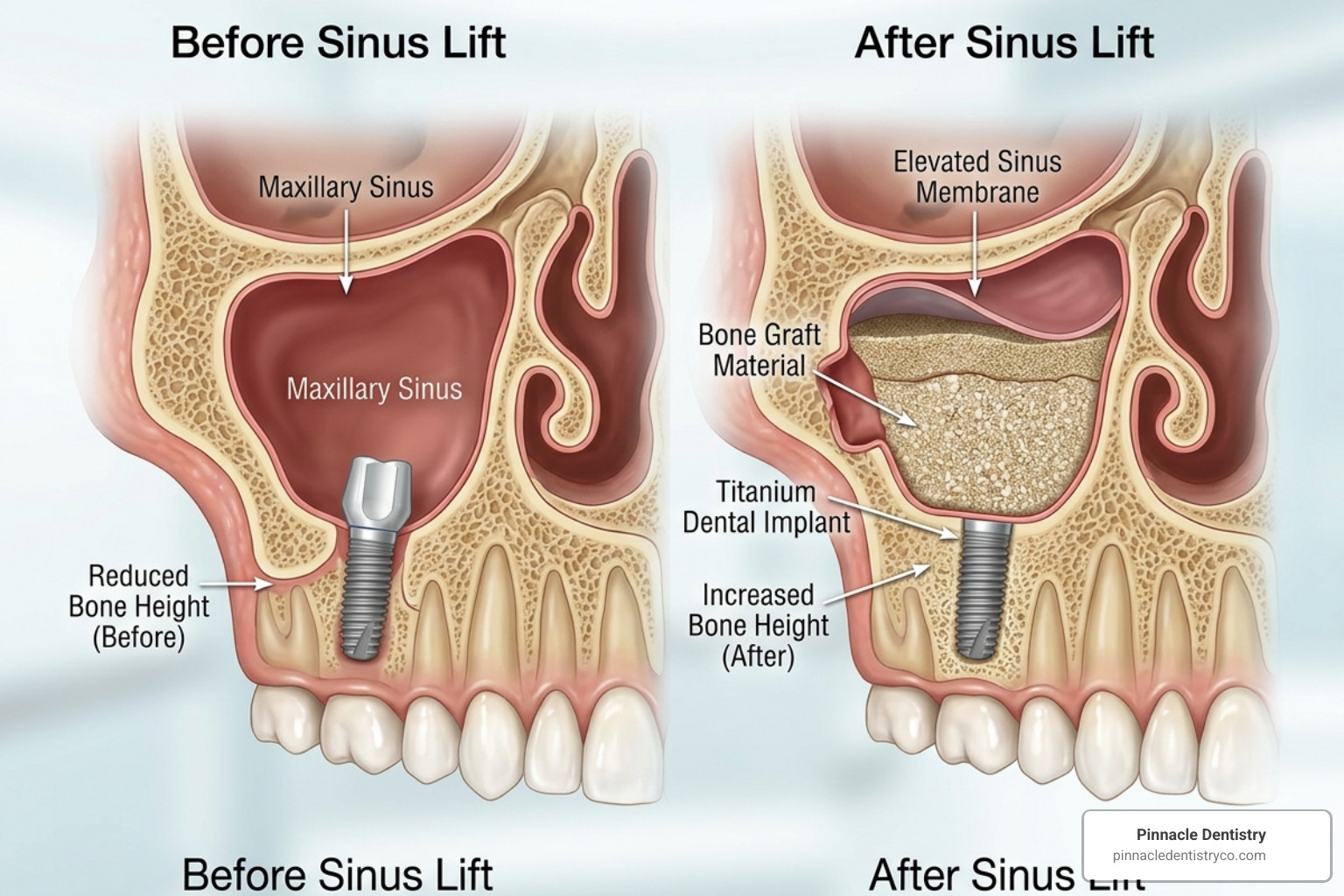
The sinus lift implant procedure is a bone grafting surgery that adds bone to the upper jaw, creating enough foundation for dental implants to be placed securely. Here’s a quick overview:
- What it is: A surgical procedure that raises the sinus membrane and packs bone graft material into the space below it
- Why it’s done: To build up bone height in the upper back jaw when there isn’t enough to support a dental implant
- Who performs it: An oral surgeon or periodontist
- How long it takes: 45 minutes to 2 hours, depending on complexity
- Healing time: 4 to 12 months before implants can be placed
- Success rate: Long-term success exceeds 90%
Losing a back tooth in your upper jaw does more than affect your smile. Over time, the jawbone in that area shrinks, and the sinus cavity can actually expand downward to fill that space. The result? Not enough bone to anchor a dental implant. That’s exactly the problem a sinus lift is designed to solve.
It’s one of the most common preparatory procedures in implant dentistry, and for most patients, it’s far less intimidating than it sounds.
I’m Dr. Thomas Jennings, DDS, MAGD, founder of Pinnacle Dentistry in Colorado Springs, with over 35 years of experience in restorative dentistry including evaluating patients for the sinus lift implant procedure. I’ll walk you through everything you need to know, clearly and without the jargon.
Understanding the Sinus Lift Implant Procedure
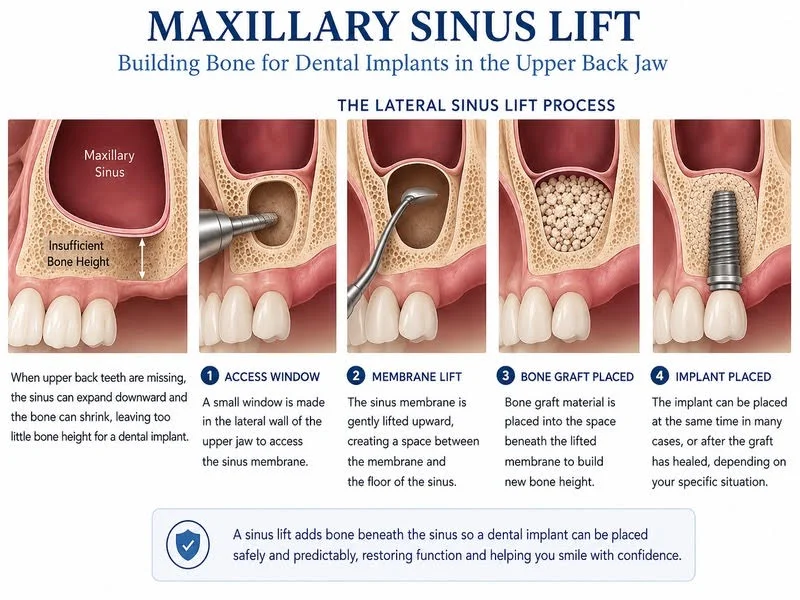
To understand why we perform a sinus lift implant procedure, we first need to look at the anatomy of your face. Your maxillary sinuses are air-filled cavities located behind your cheeks and above your upper teeth. Think of them as empty rooms sitting right on top of your upper jawbone.
The “floor” of this room is separated from your mouth by a thin layer of bone and a delicate, balloon-like lining called the Schneiderian membrane. When you have all your natural teeth, the roots extend into this bone, keeping it strong and thick. However, several factors can cause this bone to thin out:
- Tooth Loss: Once a tooth is gone, the jawbone no longer receives the stimulation it needs from chewing. The body begins to reabsorb the bone, leading to significant bone resorption.
- Periodontal Disease: Chronic gum disease can destroy the bone that supports your teeth.
- Sinus Pneumatization: This is a fancy way of saying your sinuses have naturally expanded. As we age, the sinus cavity can grow larger, “eating away” at the jawbone from the inside out.
- Natural Anatomy: Some people are simply born with very large sinuses or very thin jawbones.
At Pinnacle Dentistry, we typically recommend a sinus lift implant procedure if a patient has less than 4 to 6 millimeters of bone height in the back portion of their jaw. Without this minimum height, a dental implant would have nothing to “grip,” and it could even accidentally poke through into the sinus cavity. You can find more info about sinus augmentation on our glossary page to see how it fits into the broader world of oral surgery.
Surgical Techniques and Bone Grafting Materials
Not every sinus lift implant procedure is the same. Depending on how much bone you currently have, we choose between two primary surgical techniques:
The Lateral Window Technique (Direct Sinus Lift)
This is the traditional approach, used when significant bone volume needs to be added (usually when you have less than 4-5mm of existing bone). We create a small “window” in the bone on the cheek side of your jaw to access the sinus membrane directly.
The Osteotome Technique (Internal/Indirect Sinus Lift)
This is a less invasive method used when you already have a decent amount of bone (usually over 6mm) but just need a little “boost” of about 2-4mm. Instead of a side window, we go through the same hole where the implant will eventually sit, gently “tapping” the sinus floor upward.
Comparing the Approaches
| Feature | Lateral Window (Direct) | Osteotome (Internal) |
|---|---|---|
| Invasiveness | More invasive | Less invasive |
| Bone Gain | Significant (5mm+) | Moderate (2-4mm) |
| Membrane Tear Risk | ~19% | ~3.8% |
| Infection Risk | ~2.9% | ~0.8% |
| Recovery Time | Slightly longer | Shorter |
Bone Grafting Materials
To build that new bone, we need a “scaffold” for your body to grow into. We use several types of materials:
- Autogenous bone: Bone taken from your own body (like your chin or hip). It’s the “gold standard” but requires a second surgical site.
- Allograft: Processed bone from a human cadaver.
- Xenograft: Bone from another species, most commonly bovine (cow). Products like Bio-Oss are widely used because they integrate beautifully with human bone.
- Synthetic materials: Lab-made minerals that mimic natural bone.
- Bio-Gide: A specialized, dissolvable porcine (pig) membrane often used to protect the graft while it heals.
If you want to dive deeper into these options, check out everything to know about a sinus lift for a breakdown of graft sources.
Step-by-Step: What Happens During a Sinus Lift Implant Procedure?
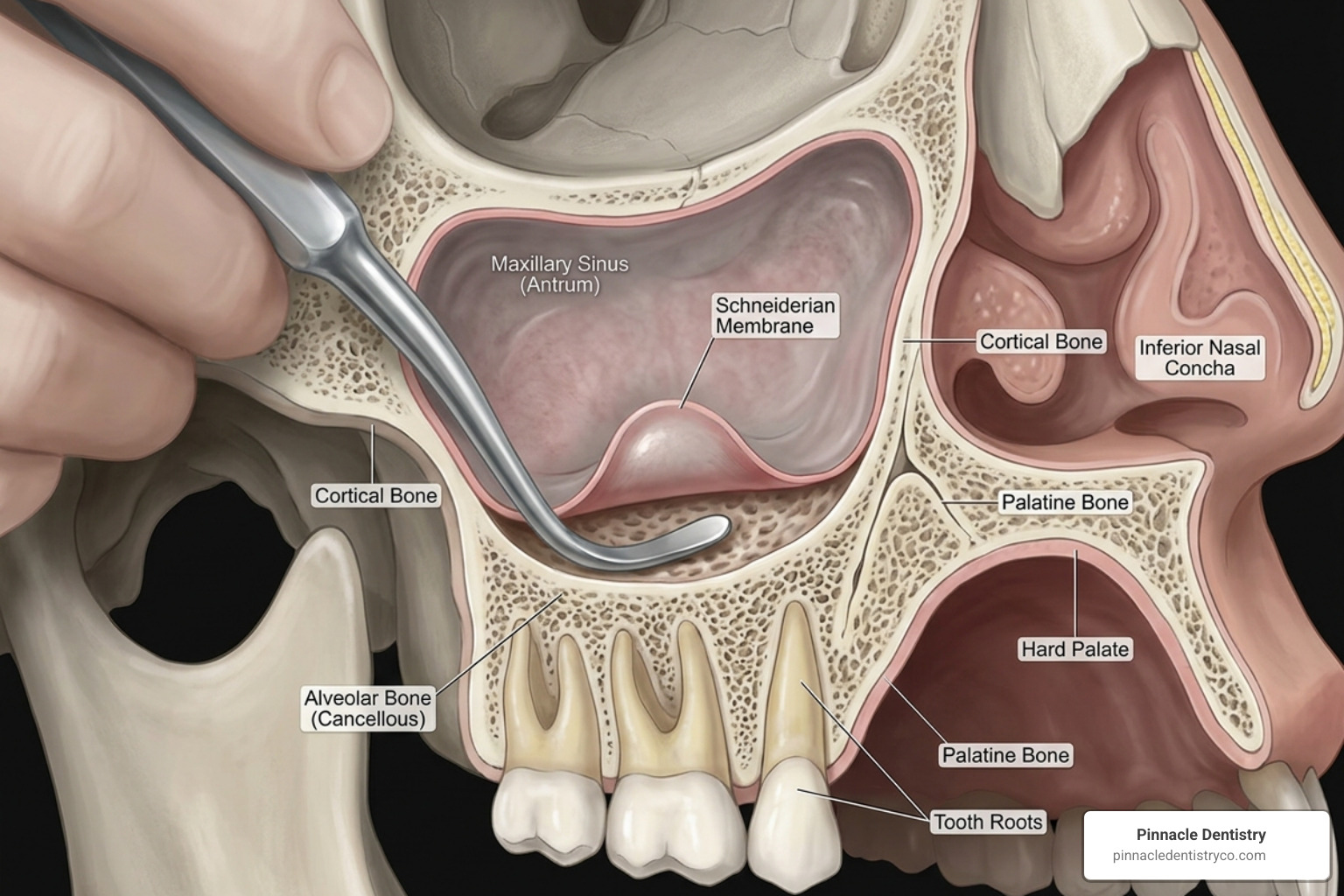
We know that “surgery” is a scary word, but the process is highly predictable. Here is exactly what happens during a typical lateral window sinus lift implant procedure:
- Anesthesia: We ensure you are completely numb using local anesthesia. Many of our Colorado Springs patients also opt for sedation to stay relaxed.
- The Incision: We make a small incision in the gum tissue where your back teeth used to be, exposing the jawbone underneath.
- The Bony Window: We use a specialized tool to cut a small, oval “trap door” into the bone.
- Membrane Lifting: This is the most delicate part. We gently push the “trap door” up into the sinus cavity, which lifts the Schneiderian membrane with it.
- Graft Placement: We pack the newly created space under the membrane with the bone graft material. This increases the height and width of the bone.
- Suturing: We close the gum tissue with stitches. If you want to see how this leads to the next step, read our dental implant surgery details.
The procedure itself usually takes between 45 minutes and two hours. Most patients are surprised to find that the “pressure” they feel is more significant than any actual pain.
Recovery, Healing, and Post-Operative Care
Once the surgery is over, the real work begins, and your body does most of it! The bone graft acts as a scaffold, and over the next several months, your natural bone will grow into and replace the graft material.
The Healing Timeline
- First 24-48 hours: Expect some swelling and mild bleeding. You might feel “fullness” in your sinus.
- 7-10 days: You’ll return to our Briargate office for a follow-up to remove stitches and check the incision.
- 4-12 months: This is the “maturation phase.” It takes this long for the bone to become hard enough to support an implant. The exact time depends on how much bone we had to add.
Post-Operative Care and Medications
We typically prescribe a “care package” of medications:
- Antibiotics: To prevent infection (infection risk is low, about 0.8% to 2.9%).
- Pain Medication: Ibuprofen or paracetamol usually does the trick.
- Decongestants/Saline Spray: To keep your sinus passages clear and reduce pressure.
- Antimicrobial Mouthwash: To keep the surgical site clean without aggressive brushing.
The “Golden Rule” of Recovery: No Blowing Your Nose!
We know it’s hard, but you must avoid blowing your nose for at least two weeks. Forceful nose blowing or sneezing can create pressure that dislodges the bone graft or tears the healing membrane. If you have to sneeze, do it with your mouth wide open, like a dragon!
Lifestyle Factors
Smoking is the biggest enemy of a successful sinus lift implant procedure. It constricts blood flow and significantly increases the risk of graft failure (which is normally only around 1.9%). If you’re a smoker in El Paso County, we strongly recommend pausing for at least a few weeks before and after the surgery.
If you’re just starting your journey, learning what to expect during your first dental implant consultation can help you prepare for these recovery discussions.
Potential Complications and Treatment Options
While the sinus lift implant procedure has a success rate exceeding 90%, it is still surgery, and risks exist.
Membrane Perforation
The most common risk is that the thin sinus membrane could puncture or tear. This happens in about 19% of external (lateral) cases and 3.8% of internal cases. If this happens, don’t panic! We can usually repair it with a patch or stitches. If the tear is large, we might stop the procedure, let it heal for a few months (the membrane actually grows back thicker and stronger!), and try again later.
Infection and Sinusitis
Infection is rare but can occur. If you develop a fever or a foul taste in your mouth, contact us immediately. In some cases, a sinus lift can trigger “acute maxillary sinusitis,” which feels like a bad cold or sinus pressure, but this usually clears up with decongestants and antibiotics.
Graft Failure
In very rare cases (about 1.9%), the graft material does not integrate with the natural bone. This is more common in smokers or patients with certain medical conditions. If a graft fails, we can often repeat the procedure after the area has healed.
For more peace of mind, you can browse these sinus lift surgery FAQs or read more info about Colorado Springs dental implants to see how we handle complications locally.
Risks and Alternatives to the Sinus Lift Implant Procedure
If you aren’t a candidate for a sinus lift or simply want to explore other options, there are alternatives:
- Shorter Implants: Modern technology allows us to use shorter, wider implants that don’t require as much bone depth.
- Angled Implants: We can sometimes angle the implants into the stronger bone toward the front of the mouth.
- Zygomatic or Pterygoid Implants: These are longer implants that anchor into the cheekbone (zygoma) or the bone further back. These are more complex and usually reserved for severe cases.
- Dental Bridges or Dentures: These don’t require bone surgery but also don’t offer the bone-preserving benefits of implants.
Frequently Asked Questions
How much does a sinus lift cost?
The cost of a sinus lift implant procedure typically ranges from $1,500 to $5,000 per side. The price varies based on:
- The amount of bone graft material needed.
- The type of material used (autogenous vs. synthetic).
- The complexity of your sinus anatomy.
- Whether you choose sedation. Some dental insurance plans cover a portion of the cost if it’s deemed medically necessary, and we offer financing options at our Colorado Springs office to make it more accessible.
Can dental implants be placed at the same time as the sinus lift?
Sometimes! This is called “simultaneous placement.” If you have enough “native” bone (usually at least 4-5mm) to hold the implant steady while the graft heals, we can do both in one day. However, if your bone is very thin, we prefer a “delayed approach.” We do the lift first, wait 4-9 months for the bone to harden, and then place the implant. This ensures the implant has a rock-solid foundation.
When should I contact my surgeon after the procedure?
While mild discomfort is normal, you should call us at Pinnacle Dentistry immediately if you experience:
- Swelling or pain that gets worse after the second day.
- Bright red, persistent bleeding that doesn’t stop with pressure.
- A feeling that the bony graft material has dislodged (you might feel small grains in your mouth).
- A high fever.
- A foul-smelling discharge from the nose or mouth.
Conclusion
The sinus lift implant procedure is a remarkable advancement in modern dentistry. It allows patients who were once told they “couldn’t get implants” to enjoy a full, functional smile again. While it adds a few months to your treatment timeline, the result, a secure, lifelong dental restoration, is well worth the wait.
At Pinnacle Dentistry, we pride ourselves on offering personalized care in a warm environment. Our team includes certified MAGD dentists, an achievement held by less than 2% of dentists nationwide, ensuring you receive the highest level of expertise right here in Colorado Springs.
Whether you are in Briargate or anywhere else in El Paso County, we are here to guide you through every step of your restorative journey. Ready to see if a sinus lift is right for you? Schedule a dental implant consultation with us today, and let’s get your smile back on track!