
What Are the Disadvantages of Dental Crowns? A Honest Look Before You Decide
The disadvantages of dental crowns are real, and worth understanding before committing to treatment. Here’s a quick summary:
Most common disadvantages of dental crowns:
- Irreversible enamel removal, Healthy tooth structure is filed down permanently to fit the crown
- Tooth sensitivity, Hot and cold sensitivity is common after placement, lasting 2-3 weeks or longer
- Risk of nerve damage, Over-preparation of the tooth can injure the nerve, sometimes requiring a root canal
- Decay under the crown, Bacteria can still cause decay at the crown margin if oral hygiene slips
- Crown damage, Crowns can chip, crack, or come loose over time
- Gum irritation, Ill-fitting crowns can inflame or recede gum tissue
- Cosmetic issues, Porcelain-fused-to-metal crowns can show a dark line at the gumline
- Allergic reactions, Rare, but possible with metal-based crowns
- High cost, Averaging around $1,000 per crown, with replacement needed every 5-15 years
Crowns are one of the most common restorative treatments in dentistry, and for many patients they’re genuinely the right call. But they’re not a small decision. The procedure is irreversible, the costs add up, and complications, while manageable, do happen.
This guide walks through every major risk honestly, so you can weigh them clearly.
I’m Dr. Thomas Jennings, DDS, MAGD, founder of Pinnacle Dentistry and a general dentist with over 35 years of experience serving families in Colorado Springs. In that time, I’ve seen how understanding the disadvantages of dental crowns upfront leads to better outcomes and fewer surprises for patients. Let’s work through what you actually need to know.
The Most Common Disadvantages of Dental Crowns
When we talk about the disadvantages of dental crowns, we aren’t saying they are “bad” treatments. In fact, they are often the only way to save a tooth that has been decimated by decay or trauma. However, because a crown is a “cap” that sits on top of your natural tooth, it changes the biology and mechanics of that tooth forever.
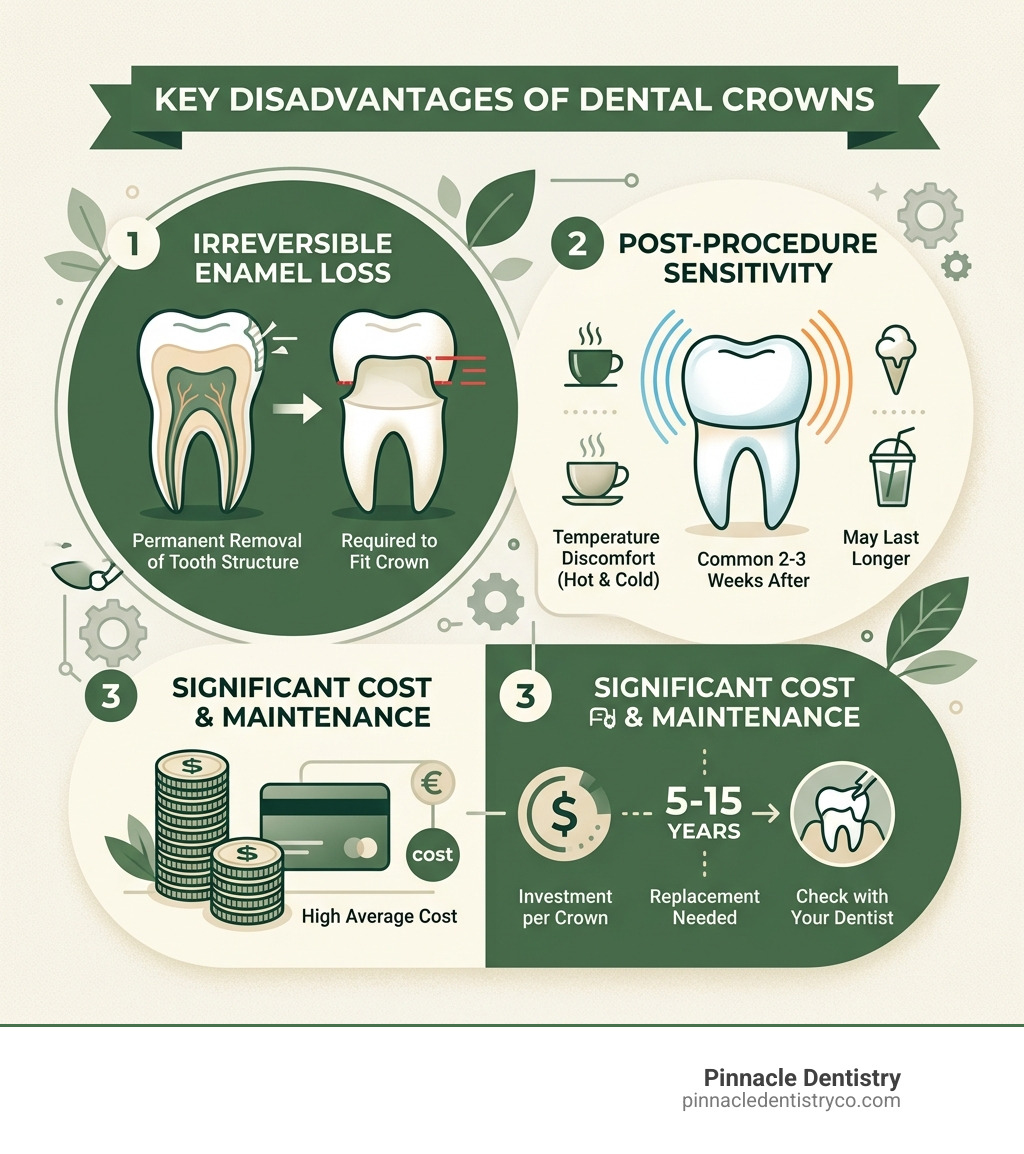
The most significant disadvantage is the irreversible nature of the preparation. To fit a crown, we must remove a portion of your natural enamel, sometimes up to 60-70% of the tooth’s original structure. Once that enamel is gone, it’s gone for good. Your tooth will always require a crown or some form of coverage to remain protected. This reduction is necessary to ensure the crown has enough thickness to be durable without making the tooth look unnaturally bulky.
Furthermore, crowns are not “set it and forget it” solutions. While they are incredibly sturdy, they have a lifespan. Most dental crowns last between 5 and 15 years, though with meticulous care, they can certainly last longer. You can find more info about crown longevity to understand why some restorations outlast others.
Managing Tooth Sensitivity: A Common Disadvantage of Dental Crowns

One of the first things patients notice after the anesthesia wears off is a new sensation in the treated tooth. Tooth sensitivity is a very common side effect. Because the enamel, the tooth’s natural insulator, has been thinned, the underlying dentin and nerves are more exposed to temperature changes.
You might feel a sharp zing when sipping hot coffee or eating ice cream. In most cases, this is temporary and subsides within 2 to 3 weeks as the tooth “settles” and the internal pulp heals from the vibration of the dental drill. However, if the crown is sits too high on the tooth, it can cause pain when you bite down. This isn’t necessarily sensitivity; it’s a bite alignment issue that your dentist can easily fix by smoothing down a high spot.
Persistent sensitivity could indicate “pulpitis,” an inflammation of the tooth’s internal pulp. While most cases of pulpitis are reversible, some may require further intervention if the nerve does not calm down.
Preventing Decay Underneath: Addressing the Disadvantages of Dental Crowns
It is a common myth that a crowned tooth cannot get a cavity. While the crown itself (made of porcelain or metal) cannot decay, the natural tooth structure underneath it certainly can.
The most vulnerable area is the “margin,” the tiny seam where the crown meets your natural tooth at the gumline. If plaque and bacteria are allowed to sit on this seam, they can seep underneath the crown. This is often called “margin leakage.” Because the decay is hidden under the cap, it can be difficult to detect without X-rays until it becomes a significant problem.
To prevent this, you must be diligent. Knowing how to protect your crown involves excellent brushing and flossing habits, specifically focusing on the gumline to ensure bacteria don’t find a way into that small gap.
Structural and Biological Risks: From Enamel to Nerves
Beyond the surface-level issues, there are deeper biological risks involved in restorative dentistry. When we reshape a tooth, we are performing a delicate surgical procedure on a living organ.
Risks of Nerve Damage and Over-Preparation
Every tooth has a “pulp chamber” containing nerves and blood vessels. If a tooth is filed too thin, what we call “over-preparation,” the heat and vibration from the dental handpiece can traumatize the nerve. In some cases, the nerve may even be accidentally exposed during the removal of deep decay.
If the nerve becomes permanently damaged or “necrotic” (dies), the tooth will require a root canal treatment. This adds significant cost and complexity to your dental journey. This is where the skill of your dentist becomes paramount. At Pinnacle Dentistry, our dentists hold MAGD (Master of the Academy of General Dentistry) certification, a distinction held by less than 2% of dentists. This level of expertise ensures that we remove only the necessary amount of tooth structure, preserving as much of your natural tooth as possible.
While it seems counterintuitive to talk about risks, crowns can still improve health by sealing off a damaged tooth, helping prevent infections, and restoring your ability to chew nutritious foods properly. For a broader clinical overview, you can review dental crowns: purpose, procedure, complications, care. For a deeper dive into the terminology, check out our understanding the purpose of crowns glossary entry.
Material-Specific Drawbacks and Cosmetic Concerns
Not all crowns are created equal. The material you choose, or the material your insurance covers, can come with its own set of disadvantages of dental crowns.
Aesthetic Limitations and Allergic Reactions
- Porcelain-Fused-to-Metal (PFM): These have been the “gold standard” for decades because they combine the strength of metal with the look of porcelain. However, a major cosmetic drawback is the “dark line” that can appear at the gumline over time as the gums recede, exposing the metal substructure.
- All-Metal Crowns (Gold or Base-Metal): These are incredibly durable and require the least amount of tooth removal. The downside? They look like metal. Unless they are placed on a back molar, most patients find them aesthetically unappealing.
- All-Ceramic or Zirconia: These are the most beautiful and natural-looking options. However, some ceramics can be prone to chipping if you have a heavy bite or a habit of grinding your teeth (bruxism).
- Allergic Reactions: While rare, some patients have sensitivities to the base metals (like nickel) used in some PFM or metal crowns. This can lead to gum irritation, swelling, or a metallic taste in the mouth.
Choosing the right material is a balance of function and beauty. During the process, you will likely wear a provisional crown, or temporary crown, while the lab crafts your permanent one. This is a great time to test the fit and feel of the restoration.
Financial Investment and Longevity Expectations
Let’s talk about the “elephant in the room”: the cost. For many families in Colorado Springs, the financial aspect is one of the primary disadvantages of dental crowns.
| Material Type | Average Cost | Estimated Lifespan | Primary Disadvantage |
|---|---|---|---|
| Gold / Metal | $800 – $1,500 | 20+ Years | Poor aesthetics |
| PFM | $800 – $1,400 | 10 – 15 Years | Dark line at gumline |
| All-Ceramic | $1,000 – $1,700 | 5 – 15 Years | Risk of chipping |
| Zirconia | $1,000 – $1,600 | 15+ Years | Can be abrasive to opposing teeth |
On average, you can expect to pay around $1,000 to $1,500 per crown. While many dental insurance plans cover up to 50% of the cost if the crown is medically necessary (due to decay or a break), they often have a “5-year rule.” This means they won’t pay for a replacement crown on the same tooth unless five years have passed.
Because crowns aren’t permanent, you have to factor in the long-term cost of replacement. If you get your first crown at age 30, you might need to replace it three or four times in your lifetime. When choosing the right long-term fix, it’s important to look at the “total cost of ownership” over several decades.
Alternatives to Dental Crowns for Minor Damage
If the disadvantages of dental crowns feel a bit overwhelming, you might be a candidate for a more conservative treatment. We always prefer to save as much natural tooth structure as possible.
- Inlays and Onlays: Often called “partial crowns,” these are used when the damage is too big for a filling but doesn’t require a full-coverage crown. They fit into the tooth like a puzzle piece.
- Porcelain Veneers: If your concerns are purely cosmetic (discoloration or minor chips on front teeth), veneers require much less enamel removal than a crown.
- Dental Bonding: For very small chips, a tooth-colored resin can be bonded to the tooth. It’s the least expensive and least invasive option, though it isn’t as durable as a crown.
In some cases, if there isn’t enough tooth structure left to hold a crown, we might recommend crown lengthening, a minor surgical procedure to expose more of the tooth.
Frequently Asked Questions about Dental Crown Risks
What are the warning signs of a failing dental crown?
You should call us immediately if you notice:
- A loose fit: If the crown wiggles or moves when you eat.
- A bad taste or smell: This often indicates bacteria and decay are trapped under the crown.
- Persistent pain: Pain when biting down or a constant ache.
- Graying gums: While sometimes just the metal showing, it can also indicate gum disease or recession.
How long does sensitivity last after getting a crown?
It’s normal to feel some zingers for 2 to 3 weeks. We recommend using a desensitizing toothpaste (like Sensodyne) during this period. If the sensitivity lasts longer or is accompanied by a “throbbing” sensation, you may need a bite adjustment or, in rare cases, a root canal.
Are dental crowns worth the potential disadvantages?
For the vast majority of patients, yes. While the disadvantages of dental crowns include cost and enamel loss, the alternative is often much worse: losing the tooth entirely. A crown restores your ability to eat, speak, and smile with confidence. It protects the structural integrity of your jaw and prevents neighboring teeth from shifting into a gap left by an extracted tooth.
Conclusion
At Pinnacle Dentistry, we believe that an informed patient is a happy patient. Understanding the disadvantages of dental crowns doesn’t mean you should fear the procedure; it simply means you can walk into our Colorado Springs office with realistic expectations and the knowledge to care for your investment.
Whether you need a simple filling or a complex restoration, our team provides personalized, expert care in a warm environment. We take pride in our MAGD-certified expertise, ensuring that your crown is placed with the highest level of precision possible.
Ready to restore your smile? Contact Pinnacle Dentistry to schedule a consultation with us today. We look forward to helping you move from a “frown” back to a healthy, beautiful “crown.”