


Being root canaled is one of the most misunderstood procedures in dentistry. Here is what you actually need to know:
- What it is: A root canal removes infected or inflamed tissue from inside a tooth, cleans the canals, and seals the tooth to save it from extraction.
- Does it hurt? No. With modern local anesthetics, most patients feel little to no pain during the procedure, similar to getting a routine filling.
- How long does it take? Most root canals are completed in one to two appointments, typically lasting 45 minutes to 2 hours.
- What is the success rate? Studies show long-term success rates near 97%, with most treated teeth still present 8 years after the procedure.
- Is it worth it? Yes. Saving your natural tooth is usually a more conservative choice than extraction and replacement with an implant or bridge.
Decades ago, root canals had a reputation for being painful and something to dread. That reputation stuck around long after the procedure itself changed completely. Today, millions of root canals are performed every year, and the vast majority of patients leave the same day, return to work, and feel relief from pain they had been living with for weeks.
If you have been told you need one and you are nervous, that is completely normal. This guide walks you through everything, from what the procedure actually involves to what recovery looks like and how long your treated tooth can last.
At Pinnacle Dentistry, our experienced Colorado Springs, CO, dental team helps patients navigate restorative treatments, including getting a tooth root canaled, with confidence. In the sections ahead, we share what you can realistically expect based on clinical evidence and the questions patients ask us every day.
What is a Root Canal and When is it Needed?
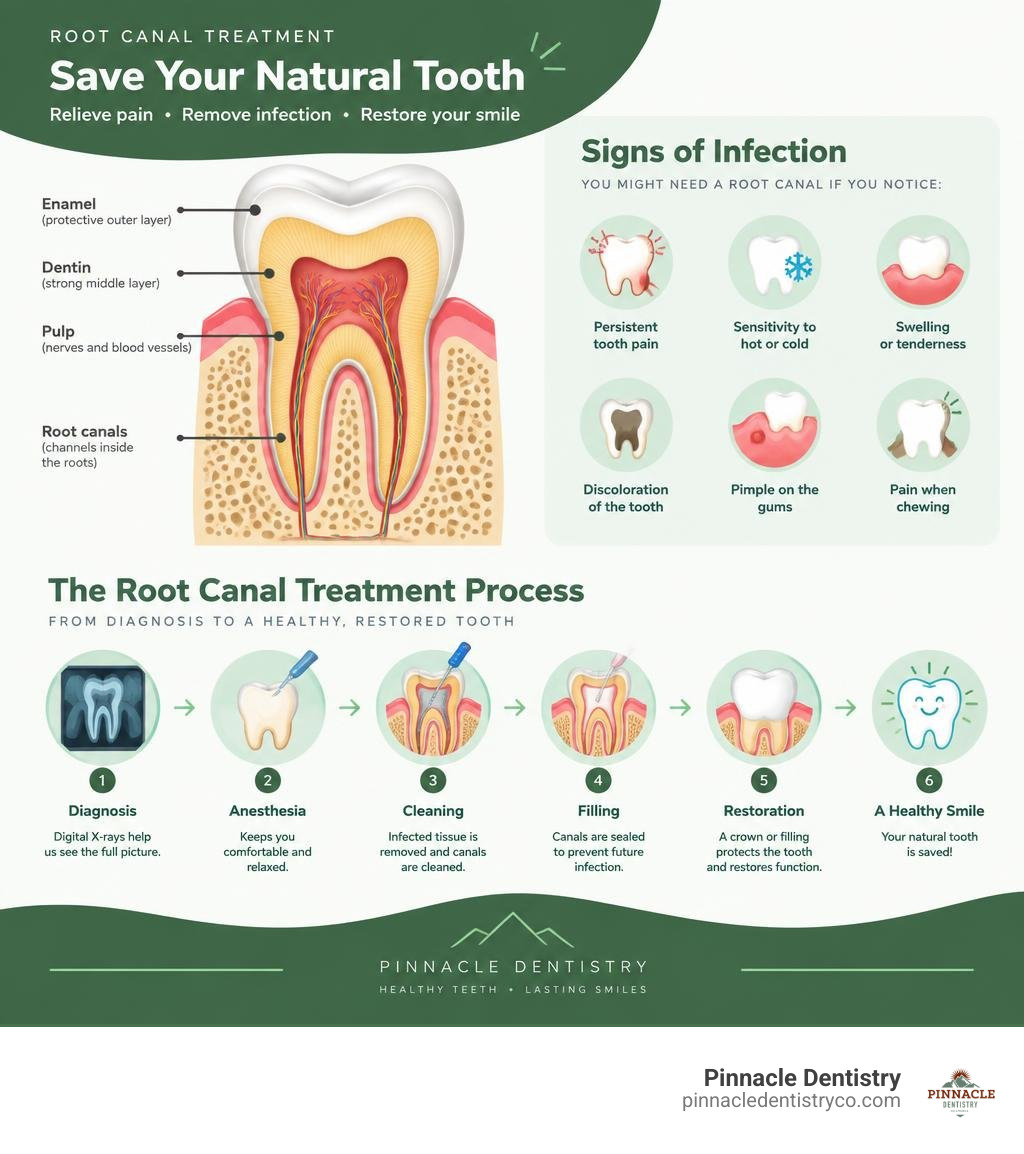
To understand how a tooth is root canaled, it helps to look at what is happening beneath the surface. Your teeth are not solid bone. They are actually composed of several distinct layers. On the outside is the enamel, the hardest substance in the human body. Beneath that is the dentin, a supportive, mineralized pathway. At the very center of the tooth, housed in a small chamber and running down through the roots, is the dental pulp.
The dental pulp is a soft tissue containing nerves, blood vessels, and connective tissue. While the pulp is vital for a tooth as it grows and develops, a fully mature tooth can survive without it because the surrounding tissues continue to nourish the tooth from the outside.
When deep tooth decay, repeated dental procedures, or physical trauma damage this inner chamber, bacteria can enter and infect the pulp. This leads to an inflammatory condition known as pulpitis. If left untreated, pulpitis can progress from reversible to irreversible, meaning the tissue cannot heal itself. Eventually, the pulp dies, and the infection can spread past the roots into the surrounding jawbone, causing a painful dental abscess.
Lingering temperature sensitivity, pain when chewing, and gum swelling can be warning signs that deserve a prompt dental evaluation. Our article on how to know if you need a root canal explains how these symptoms can appear before treatment is needed.
Other warning signs include:
- Severe pain while chewing or applying pressure to the tooth.
- Lingering tooth sensitivity to hot or cold temperatures, even after the temperature source is removed.
- Discoloration or darkening of the affected tooth.
- Swollen, tender, or pimple-like bumps on the gums near the painful area.
- A persistent, dull ache radiating into your jaw, ear, or temple.
At Pinnacle Dentistry, our primary goal is saving natural teeth. Retaining your natural tooth structure keeps your bite strong, prevents adjacent teeth from shifting, and maintains the natural contours of your jawbone.
Is a Root Canal Painful? Dispelling the Myths
The idea that a root canal is an agonizing experience is one of the most stubborn myths in modern medicine. Decades ago, before the advent of advanced local anesthetics and precise dental techniques, dental procedures were certainly more uncomfortable. Today, however, the reality is entirely different.
When you undergo endodontic therapy, we use highly effective local anesthetics to completely numb the tooth and the surrounding tissues. In fact, most patients report that the procedure is no more uncomfortable than receiving a standard cavity filling. If you are experiencing severe pain before your visit, the root canal can relieve that pain by removing the diseased, dying nerve that is causing your distress. Living with an untreated, infected tooth is often far more painful than the treatment itself.
For patients who experience dental anxiety, Pinnacle Dentistry offers customized sedation options, including nitrous oxide and oral sedation, to help you feel relaxed throughout your visit.
Knowing what sensations are normal before, during, and after treatment can make the appointment feel much more manageable. Our explanation of root canal pain before, during, and after provides a practical overview for patients preparing for care. Harvard Health also outlines how modern clinical protocols have made this tooth-saving therapy a comfortable, routine experience.
The Step-by-Step Root Canal Procedure
If you are curious about what actually happens during the procedure, Pinnacle Dentistry believes in complete transparency. Understanding the clinical steps can help ease anxiety.
Root canal treatment is designed to remove infection while preserving as much healthy tooth structure as possible. Our endodontics and root canals service page explains how our team evaluates and treats damaged or infected teeth in Colorado Springs, CO.
Here is a step-by-step breakdown of how we perform a root canal at Pinnacle Dentistry:
- Diagnosis and Imaging: We begin by taking digital X-rays or a 3D CBCT scan of the tooth. This allows us to see the exact shape of the root canals and assess the extent of the infection in the surrounding bone.
- Anesthesia: We apply a topical numbing gel to your gums before gently administering a local anesthetic to ensure you do not feel discomfort.
- Rubber Dam Placement: We place a thin, protective sheet of latex or silicone, called a rubber dam, over the tooth. This isolates the treated tooth, keeping it dry and sterile from saliva while protecting your airway.
- Access Cavity Creation: We make a small opening in the crown of the tooth to access the infected pulp chamber.
- Cleaning and Shaping: Using precise, flexible nickel-titanium rotary files and electronic apex locators, we gently remove the diseased pulp tissue. We then clean and shape the microscopic canals.
- Chemical Disinfection: We flush the canals with disinfecting solutions, such as sodium hypochlorite, to eliminate remaining bacteria.
- Obturation (Filling the Canals): Once the canals are sterile and dry, we fill them with a biocompatible, rubber-like material called gutta-percha. This material is compacted into the canals with a sealer cement to create a secure seal.
- Temporary Filling: We place a temporary restoration over the access opening to protect the inner tooth from bacteria between appointments.
- Final Restoration: At a subsequent visit, we place a permanent restoration, often a custom dental crown, to rebuild the tooth’s strength.
The sequence is easier to follow when you understand the purpose of each clinical step. Our article on how a root canal works gives additional context about the science behind the treatment.
Caring for Your Root Canaled Tooth: Recovery and Aftercare
Once your procedure is complete, the recovery phase is typically straightforward. Most of our patients in Colorado Springs, CO, are able to return to work or school immediately after their appointment. However, there are a few important guidelines to keep in mind to support smooth healing.
First, you will remain numb for approximately 2 to 4 hours following the procedure. It is important to avoid eating or drinking hot liquids during this time to prevent accidentally biting your tongue, cheek, or lip.
Once the numbness wears off, you may experience mild soreness, tenderness, or a bruised sensation around the treated tooth for a few days. This is normal and reflects your body’s healing process in the surrounding ligament and bone. You can often manage mild discomfort using over-the-counter pain relievers such as ibuprofen or acetaminophen.
Soft foods, gentle chewing, and protecting a temporary filling can reduce stress on the treated tooth while it heals. Our root canal aftercare guidance covers the practical steps patients can take in the days after treatment.
How long does a root canaled tooth typically last?
When a tooth is properly restored, its long-term success rate is very high, near 97%. A large clinical study tracking more than 1.6 million patients found that 97% of treated teeth were still healthy and retained 8 years after the procedure.
The longevity of your treated tooth depends heavily on getting a permanent restoration promptly. Because the tooth no longer has a living pulp, it can become more brittle over time. A high-quality dental crown protects the remaining structure from fracturing under normal chewing forces. With excellent oral hygiene and routine dental cleanings, a restored tooth can last a lifetime.
Can a root canaled tooth get infected again?
While rare, it is possible for a treated tooth to develop a new infection months or even years later. This is often referred to as a failed root canal. This can happen for several reasons, including:
- Microleakage: If the final crown or filling is delayed, loose, or cracked, bacteria from your saliva can leak back into the inner chambers of the tooth.
- Missed Canals: Tooth anatomy is complex. For example, a maxillary molar may have a hidden fourth canal, called the MB2 canal. If this small canal is missed during initial treatment, bacteria can survive and multiply.
- New Decay: A treated tooth can still develop a cavity around the edge of its crown, allowing new bacteria to enter the root system.
If a tooth becomes reinfected, Pinnacle Dentistry can often help save it through root canal retreatment, which involves removing the old filling material, cleaning and disinfecting the canals again, and placing a new seal.
Alternatives to Root Canal Therapy
If you are facing the prospect of having a tooth treated, you might wonder if there are other options. The only true alternative to saving a tooth with a root canal is extracting it.
To help you visualize how these two paths compare, consider the long-term impact of each decision.
While extracting a damaged tooth might seem like a quick fix, it can lead to more complex oral-health concerns. When a tooth is removed, surrounding teeth can begin to drift into the empty space. This may alter your bite, make chewing harder, and increase the risk of future decay and gum disease on your remaining teeth.
Replacing a missing tooth with an implant or bridge may be appropriate in some situations, but preserving a natural tooth whenever possible is generally the most conservative approach. Pinnacle Dentistry can help you understand which option best supports your oral health.
Frequently Asked Questions About Root Canals
How long does a root canal procedure take?
On average, the active portion of a root canal takes between 45 minutes and 2 hours. The exact duration depends on which tooth is being treated. Front teeth typically have only one root canal and are faster to clean, while back molars are anatomically complex, with three to four canals, requiring more time to disinfect and seal.
Can a root canal be completed in a single visit?
Yes, many straightforward root canals are completed in a single appointment. However, if you have a severe infection, a large dental abscess, or a highly inflamed tooth, we may recommend a two-visit approach. During the first visit, we clean the canals and place a calming, antibacterial medication inside the tooth, allowing the infection to resolve before we place the permanent seal at your second visit.
What happens if I delay my root canal treatment?
Delaying treatment allows the bacterial infection inside your tooth to grow and spread. Over time, the infection can damage the surrounding jawbone and lead to a painful abscess or severe facial infection. Eventually, the tooth can degrade to the point where it can no longer be saved and must be extracted.
Is a root canal safe for my overall health?
Yes. Root canal treatment is considered safe and is used to remove infection from inside a tooth. The historical claim that root-canaled teeth cause systemic illness, known as the focal infection theory, was based on flawed early research and is not supported by modern medical and dental science. Preserving your natural tooth can also prevent complications associated with untreated oral infections.
Why does my tooth need a crown after a root canal?
A tooth that requires a root canal has usually already lost significant structure to deep decay or fractures. Removing the inner pulp can also leave the tooth more vulnerable to fracture over time. A custom dental crown covers the tooth, restoring its structural integrity and protecting it from heavy chewing forces.
Can a root canal cause sinus pressure?
The roots of your upper molars sit close to your maxillary sinus cavities. When these upper teeth are deeply infected, the inflammation can cause localized sinus pressure or congestion. Following a root canal, this sinus-like pressure should steadily resolve as the tooth heals.
How much does a root canal cost with insurance?
Coverage and out-of-pocket responsibility vary based on your dental benefits, the tooth being treated, and whether a crown is needed. Pinnacle Dentistry can review your benefits and discuss available payment options before treatment begins.
What should I eat immediately after a root canal?
Immediately after your procedure, stick to soft, room-temperature foods that require minimal chewing, such as applesauce, mashed potatoes, scrambled eggs, yogurt, and smoothies. Avoid hot liquids while you are still numb, and stay away from hard, crunchy, or sticky foods that could dislodge your temporary filling.
What is the difference between a root canal and a pulpotomy?
A root canal involves removing the entire pulp tissue from both the crown and the roots of the tooth. A pulpotomy is a partial pulp therapy, typically performed in pediatric dentistry on primary teeth, where only the diseased pulp in the upper crown portion is removed, leaving the healthy root pulp intact.
When should I contact my dentist after the procedure?
You should contact your dentist if you experience visible swelling inside your mouth or on your face, severe pain that does not respond to over-the-counter medications, an allergic reaction to prescribed medications, or if your temporary filling falls out completely.
Conclusion
Facing a root canal does not have to be an anxious experience. With modern dental technology, advanced local anesthetics, and the guidance of highly trained professionals, getting a tooth root canaled is a comfortable, routine process designed to relieve pain and protect your smile for a lifetime.
At Pinnacle Dentistry, our Colorado Springs, CO, team provides personalized restorative dentistry with a gentle, patient-centered approach. Our dentists hold MAGD certification, a distinction earned by fewer than 2% of general dentists nationwide, and are committed to delivering a high standard of care.
If you are experiencing tooth pain, sensitivity, or have questions about saving your natural smile, contact our root canal specialists to schedule an appointment with Pinnacle Dentistry.