
What “Endo” Actually Means in Dentistry (And Why It Matters for Your Teeth)
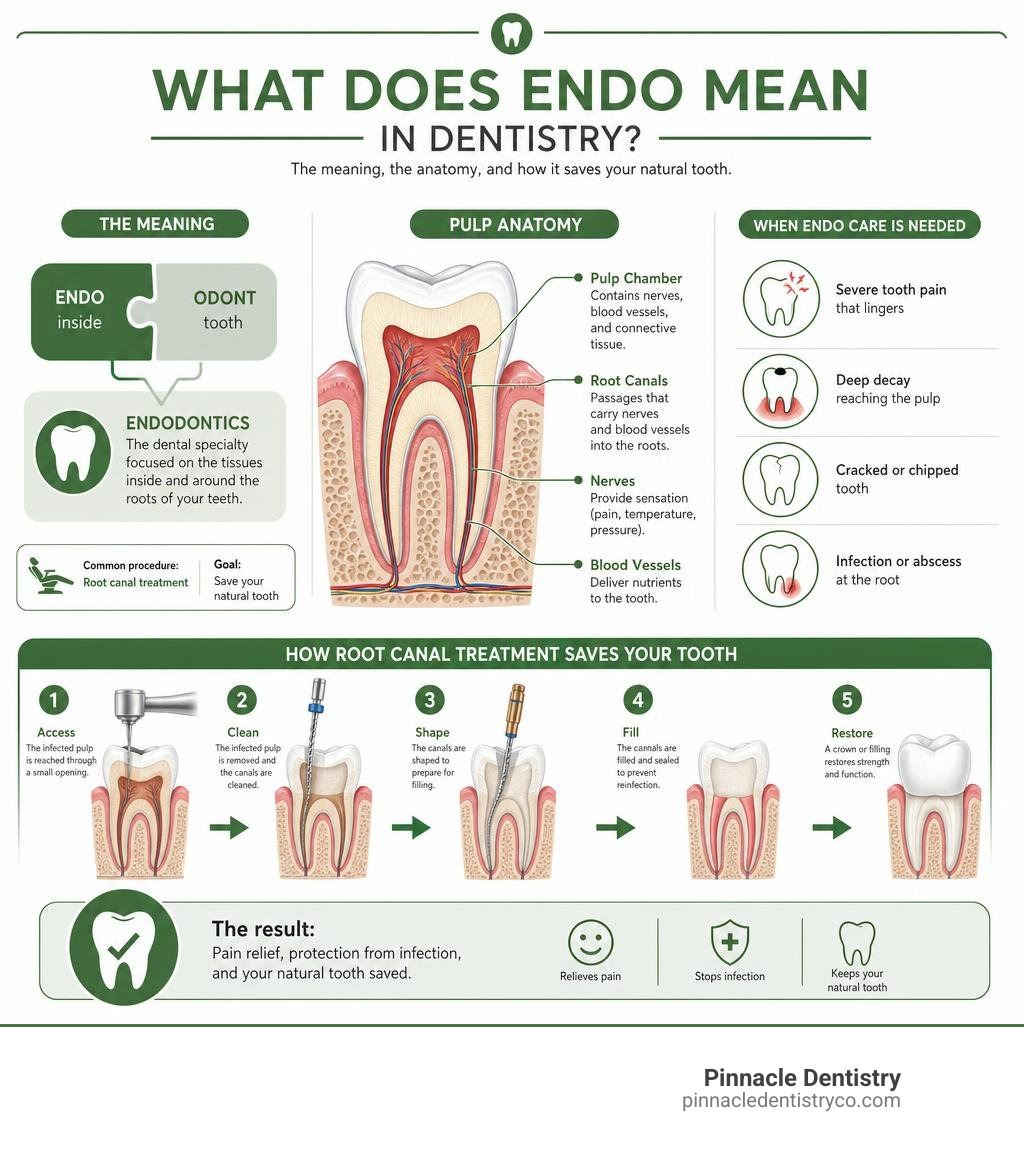
What does endo mean in dentistry comes down to two Greek words: endo (inside) and odont (tooth). Together, they describe the branch of dentistry focused on the inner structures of your teeth, specifically the pulp, nerves, blood vessels, and the canal system running through each root.
Quick answer:
| Term | Meaning |
|---|---|
| Endo | Greek for “inside” |
| Odont | Greek for “tooth” |
| Endodontics | The dental specialty focused on the tissues inside and around the roots of your teeth |
| Common procedure | Root canal treatment |
| Goal | Save your natural tooth by treating infected or inflamed pulp |
If you have ever had a toothache that just would not quit, or been told you might need a root canal, you have already encountered endodontics, even if the word itself was new to you. More than 15 million teeth are saved every year through endodontic treatment, and the success rate sits around 90%. That makes it one of the most effective tooth-saving options in modern dentistry.
This guide breaks down everything you need to know, from what the word means to what the treatment actually involves, so you can make confident decisions about your family’s dental care.
I’m Dr. Thomas Jennings, a general dentist with over 35 years of experience serving families in Colorado Springs, CO, and a Master of the Academy of General Dentistry (MAGD). My understanding of what does endo mean in dentistry shapes how I approach tooth preservation and when I collaborate with or refer patients to endodontic specialists for the best possible outcomes.
What Does Endo Mean in Dentistry?
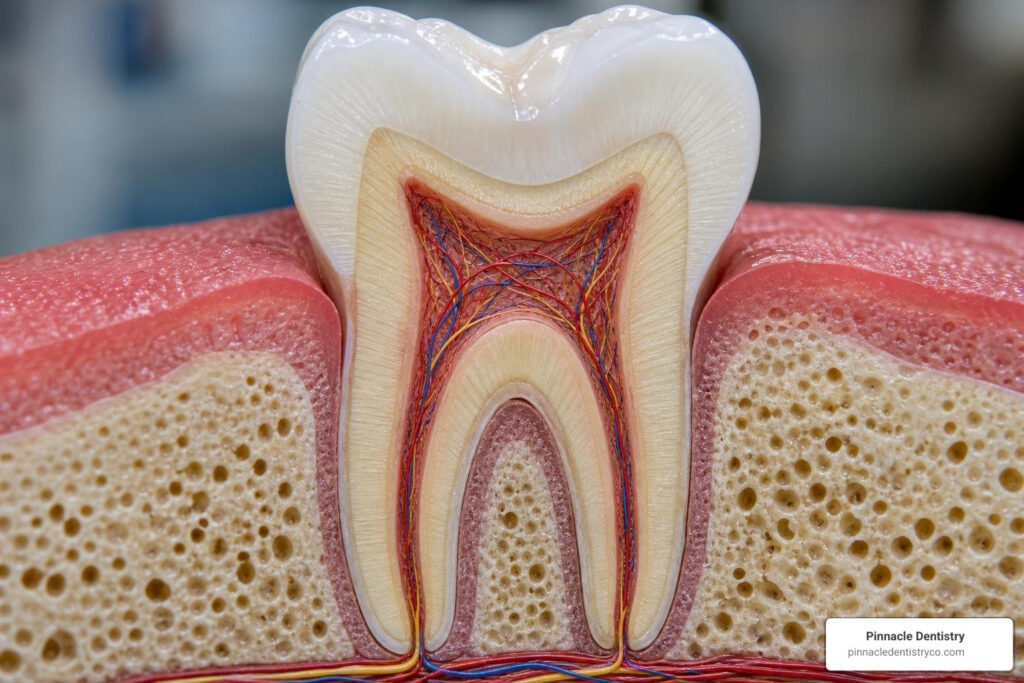
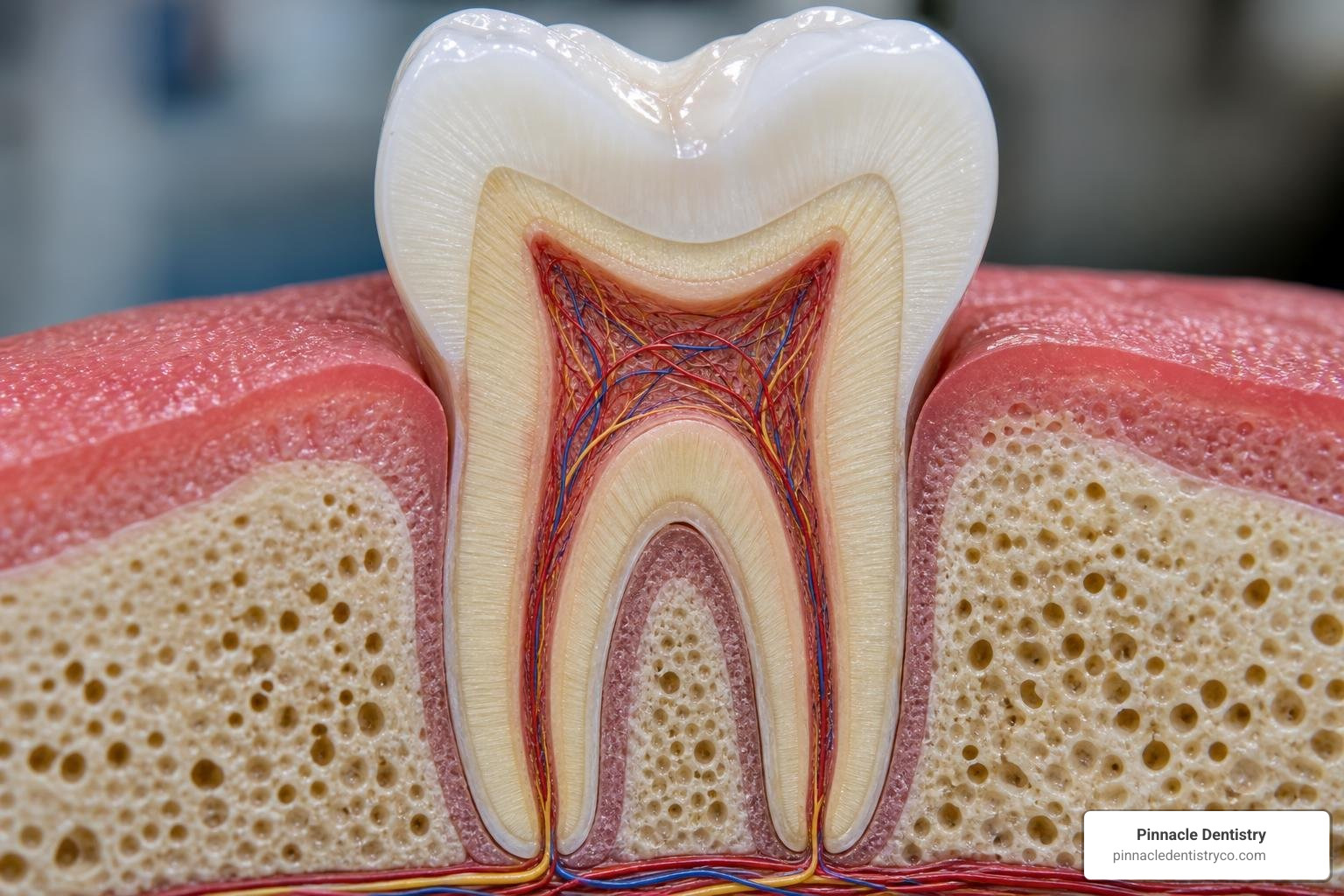
“Endo” means “inside,” and in dentistry it refers to care involving the inside of the tooth. The full word “endodontics” combines “endo” with “odont,” meaning tooth. A related term, endodontology, is often described as the study or knowledge of what is inside the tooth.
That “inside” is more than an empty space. It includes the pulp chamber, root canals, nerves, blood vessels, connective tissue, and tissues around the root tip. These structures help a developing tooth grow, sense temperature, and respond to injury or infection.
When the pulp becomes inflamed, infected, or injured, endodontic care may be needed to relieve pain and save the tooth.
What Does Endo Mean in Dentistry for Patients?
For patients, “endo” usually means one simple thing: we are checking or treating a problem inside the tooth.
That may involve:
- A deep cavity that has reached the pulp
- A cracked tooth causing pain when biting
- Lingering sensitivity to hot or cold
- A dental abscess near the root
- A tooth injury from sports, falls, or accidents
- A tooth that needs root canal therapy to avoid extraction
In plain language, endodontics is tooth-saving care. It focuses on diagnosing the source of tooth pain early, removing infection when needed, and helping you keep your natural tooth whenever possible.
What Endodontics Focuses on Inside and Around the Tooth
Endodontics focuses on several small but important structures:
- Dental pulp: The soft inner tissue containing nerves, blood vessels, and connective tissue.
- Pulp chamber: The central space inside the crown of the tooth.
- Root canals: Narrow channels that run through the tooth roots.
- Root apex: The tip of the root where nerves and blood vessels enter.
- Periapical tissues: Tissues and bone around the root tip.
- Dentin: The tooth layer surrounding the pulp, which can transmit sensitivity.
- Periodontal connection: The relationship between root health, gum health, and surrounding bone.
For a deeper academic overview, the scientific overview of endodontology explains the field as the knowledge of what is inside the tooth.
How “Endo” Differs from General Dental Care
General dentistry covers the full picture of oral health: prevention, cleanings, fillings, crowns, cosmetic care, gum health, bite function, and more. Endodontics narrows the focus to the inner tooth and root system.
At Pinnacle Dentistry, we provide comprehensive dental care in Colorado Springs, CO, including diagnosis, prevention, restorative treatment, and root canal care when appropriate. You can learn about endodontics and root canal services if you want to understand how this care fits into your overall treatment plan.
What Endodontics Includes: Procedures, Specialists, and Tooth-Saving Treatment
Endodontics includes much more than root canals, though root canal treatment is the procedure most people recognize. Endodontic care can include early pulp therapy, retreatment, surgical procedures, dental trauma management, abscess treatment, cracked tooth diagnosis, and restoration planning after treatment.
More than 15 million teeth are treated and saved each year with endodontic treatment. Well over 14 million root canal procedures are performed annually, and root canal success is commonly estimated around 90% when cases are properly diagnosed, treated, and restored.
Root Canal Treatment: The Most Common Endodontic Procedure
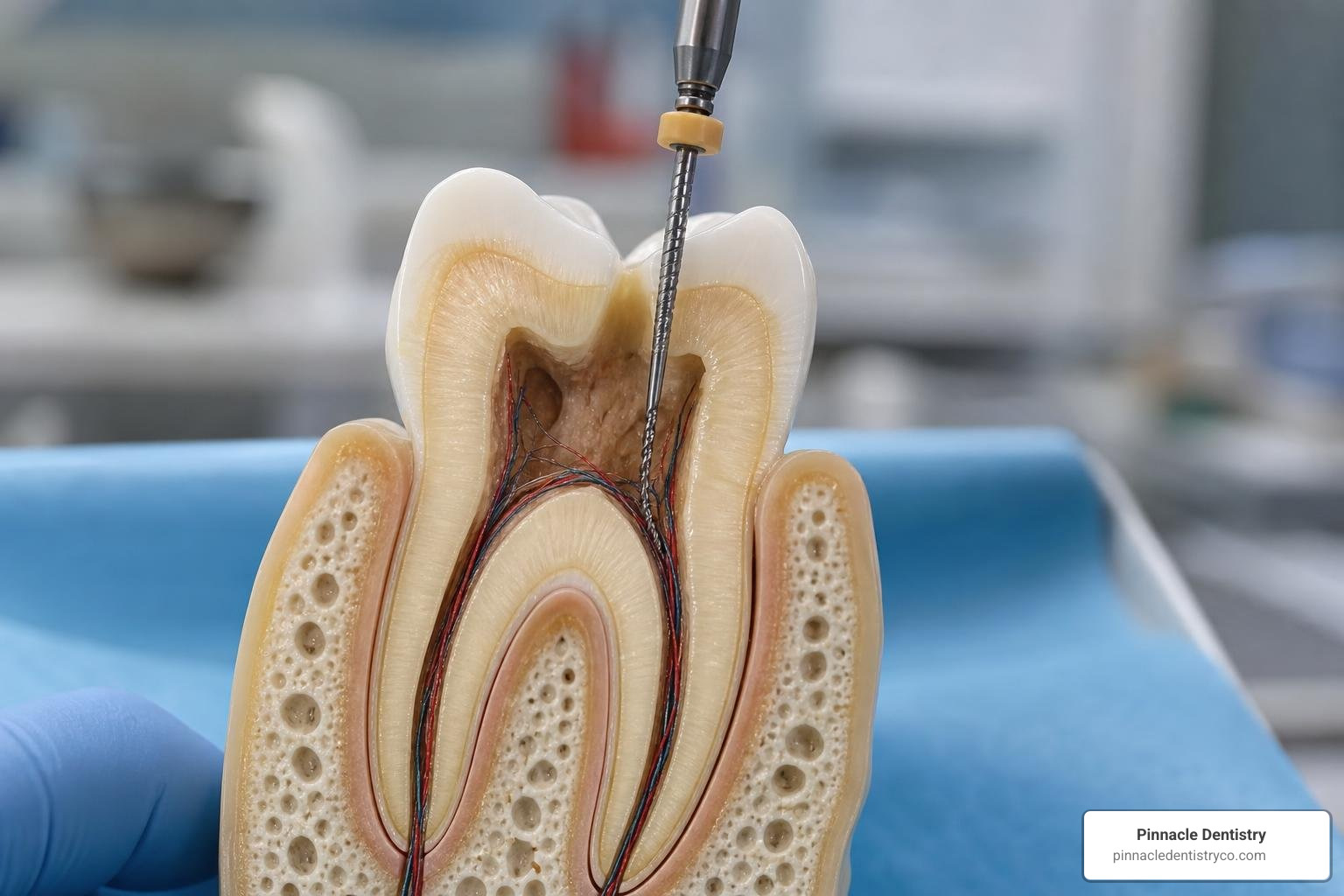
A root canal treats infected or inflamed pulp inside the tooth. Despite its spooky reputation, modern root canal therapy is usually performed with local anesthesia and a comfort-focused approach. It is not a punishment from the dental universe.
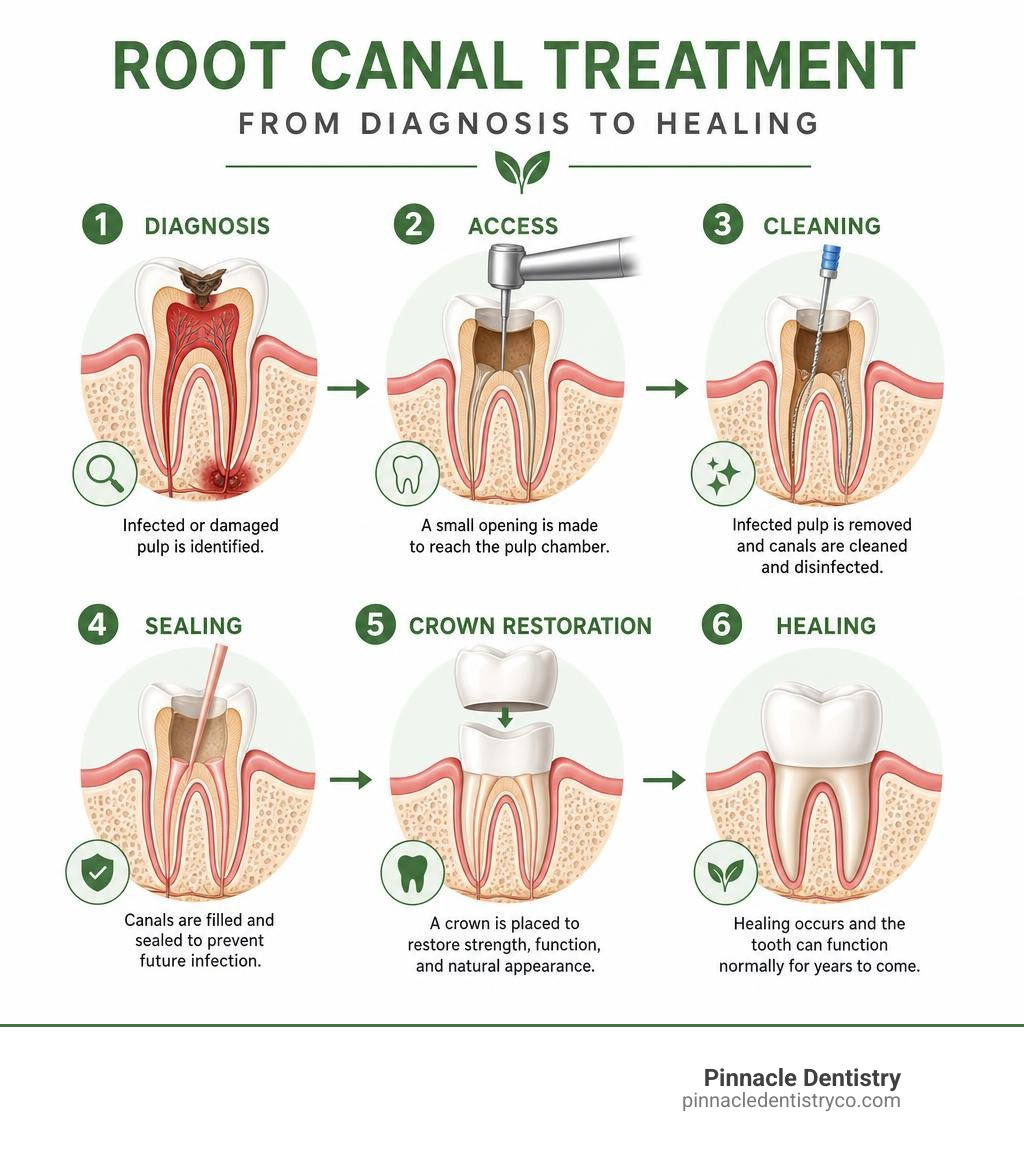
Typical steps include:
- Numbing the tooth and surrounding area.
- Isolating the tooth with a dental dam to keep it clean and dry.
- Creating a small access opening.
- Removing inflamed or infected pulp.
- Cleaning, shaping, and disinfecting the canals.
- Filling and sealing the canal system.
- Placing a temporary or permanent restoration.
- Restoring the tooth with a crown or other protective restoration when needed.
To better understand the process, read our guide on how a root canal works.
Endodontic Retreatment When a Tooth Needs a Second Chance
Sometimes a tooth that had previous root canal treatment becomes painful or infected again. This can happen because of:
- A missed or complicated canal
- New decay
- A cracked filling or crown
- Delayed permanent restoration
- Leakage around an old restoration
- Complex root anatomy
Retreatment involves reopening the tooth, removing the old filling material, cleaning the canals again, and resealing the tooth. In many cases, retreatment can save a tooth that might otherwise be lost. You can read about endodontic retreatment for more detail.
Vital Pulp Therapy and Early Intervention
Not every pulp problem requires a full root canal. Vital pulp therapy may be recommended when the pulp is irritated or exposed but still healthy enough to heal.
This approach may be used for:
- Reversible pulpitis
- Young permanent teeth
- Small pulp exposures
- Early-stage inflammation
- Teeth where preserving living pulp tissue is possible
Vital pulp therapy may involve removing damaged tissue, placing a protective material, and sealing the tooth so it can heal. The goal is conservative care: treat the problem early and preserve as much natural tissue as possible. Learn more about vital pulp therapy.
Surgical Endodontics and Apicoectomy
When infection persists near the root tip after root canal treatment, surgical endodontics may be considered. The most common procedure is an apicoectomy, also called root-end surgery.
During an apicoectomy, the clinician accesses the root tip through the gum tissue, removes infected tissue, trims the root end, seals it, and allows the bone to heal. This is often considered when anatomy, previous treatment, or persistent infection makes conventional retreatment less predictable.
Restoring Endodontically Treated Teeth After Care
After endodontic treatment, the tooth often needs a strong restoration. Back teeth, especially molars, handle heavy chewing forces and are more likely to need a crown.
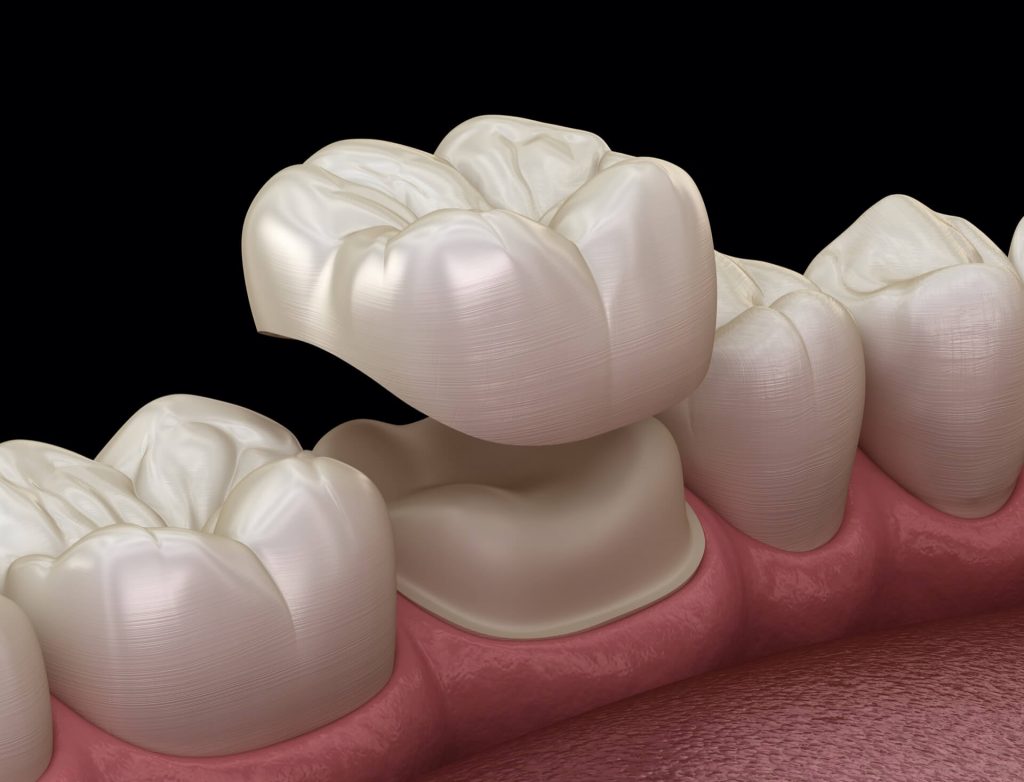
Restorative options may include:
- A permanent filling for smaller access openings
- A crown for strength and protection
- An endocrown for certain heavily restored molars
- Adhesive restorations that preserve remaining tooth structure
Endocrowns are conservative restorations that use the pulp chamber for retention rather than placing a post deep into the root canal. Research continues to evaluate materials, preparation depth, and long-term outcomes, but the key principle is the same: protect the treated tooth so it can function naturally.
Endodontist vs. General Dentist: Training, Tools, and When Each Helps
An endodontist is a dentist who completes dental school and then two or more additional years of advanced specialty training in endodontics. Less than 3% of dentists receive this extra training.
General dentists and endodontists often work together. A general dentist may diagnose the problem, perform routine root canals, restore the tooth, and refer complex cases to an endodontist.
| Care area | General dentist | Endodontist |
|---|---|---|
| Training | Dental degree | Dental degree plus 2 or more years of endodontic specialty training |
| Focus | Overall oral health, prevention, restorative care | Tooth pulp, root canals, complex pain, trauma |
| Common role | Diagnosis, routine care, crowns, follow-up | Complex root canals, retreatment, surgery |
| Tools | Digital imaging, diagnostic testing, restorative tools | Often uses microscopes, CBCT imaging, specialty instruments |
| Best fit | Comprehensive family dental care | Complicated anatomy, persistent pain, failed prior treatment |
At Pinnacle Dentistry, our MAGD distinction reflects an advanced commitment to continuing education. Fewer than 2% of general dentists achieve Mastership in the Academy of General Dentistry, and that training helps us provide thorough care and know when a specialist referral is best.
What an Endodontist Does
Endodontists diagnose and treat problems involving the pulp and root tissues. Their work often includes:
- Root canal treatment
- Root canal retreatment
- Apicoectomy and other surgical endodontics
- Dental trauma care
- Cracked tooth evaluation
- Abscess treatment
- Complex pain diagnosis
- Management of calcified or curved canals
They often use dental microscopes, digital imaging, and 3D CBCT imaging for complicated cases.
How Endodontist Training Differs from General Dentistry
Endodontists complete advanced postgraduate training focused on:
- Root canal anatomy
- Pulp biology
- Pain diagnosis
- Dental trauma
- Microsurgical techniques
- Advanced imaging
- Complex canal systems
- High-volume root canal treatment
Because they treat many endodontic cases, they develop specialized experience with unusual anatomy and difficult symptoms.
When a General Dentist May Treat Endodontic Problems
A general dentist may treat many routine endodontic problems, especially when the tooth anatomy is straightforward and the case is predictable. General dentists also play a major role in:
- Detecting early pulp disease
- Treating decay before it reaches the pulp
- Performing routine root canals
- Placing permanent crowns
- Monitoring healing
- Coordinating referrals when needed
This continuity matters. Saving a tooth is not just about cleaning the canal. It is also about restoring the tooth properly afterward.
Why Specialist Collaboration Can Improve Outcomes
The best care is not about “general dentist versus specialist.” It is about matching the treatment to the tooth.
Collaboration can improve:
- Diagnosis accuracy
- Treatment efficiency
- Pain relief
- Root canal success
- Restoration timing
- Long-term tooth protection
If you are comparing treatment options, our overview of endodontic therapy explains how these procedures work together to preserve natural teeth.
Symptoms, Conditions, and Diagnostic Tests That May Lead to Endodontic Treatment
Endodontic problems can be obvious, subtle, or downright sneaky. Some teeth hurt intensely. Others develop silent infections visible only on X-rays.
Warning signs may include:
- Persistent toothache
- Lingering sensitivity to hot or cold
- Pain when biting or chewing
- Swollen gums
- Facial swelling
- A pimple-like bump on the gums
- Tooth discoloration
- Deep decay
- Cracked or fractured tooth
- Trauma to a tooth
- Bad taste or drainage
- Jaw or ear pain that may be referred from a tooth
Common Symptoms That Suggest Pulp Trouble
Pulp inflammation or infection can cause:
- Sharp pain
- Throbbing pain
- Sensitivity that lingers after cold drinks
- Heat sensitivity that worsens
- Pain with sweets
- Pressure pain
- Tenderness to tapping
- Gum swelling
- Facial swelling
- Tooth darkening
Not every toothache means root canal treatment is needed, but lingering or worsening symptoms should be evaluated promptly.
Conditions Endodontics Commonly Treats
Endodontic care may be used for:
- Pulpitis: Inflammation of the pulp, which can be reversible or irreversible.
- Necrotic pulp: Pulp tissue that has died.
- Dental abscess: Infection near the root tip.
- Deep cavities: Decay extending toward the pulp.
- Cracked teeth: Fractures that irritate or expose the pulp.
- Traumatic injuries: Dislodged, loosened, or knocked-out teeth.
- Resorption: Loss of tooth structure from internal or external processes.
- Calcified canals: Narrowed canals that are harder to treat.
- Perio-endo lesions: Combined gum and root-related infections.
Combined periodontal and endodontic problems require careful diagnosis. Clinical research on perio-endo lesions emphasizes the importance of thorough examination and appropriate treatment sequencing. You can also learn more about pulpitis and how pulp inflammation develops.
Diagnostic Tools Endodontists and Dentists Use
To diagnose pulp and root problems, dentists and endodontists may use:
- Digital X-rays
- 3D CBCT imaging when needed
- Cold testing
- Heat testing
- Electric pulp testing
- Percussion testing, or gently tapping the tooth
- Bite tests
- Palpation of gum and bone tissue
- Periodontal probing
- Transillumination to look for cracks
- Selective anesthesia to isolate confusing pain
- A detailed symptom history
Diagnosis matters because tooth pain can be referred. A problem in one tooth may feel like pain in another tooth, the jaw, ear, or head.
When Tooth Pain Becomes a Dental Emergency
Seek urgent evaluation if you have:
- Severe swelling
- Fever
- Spreading facial redness
- Trouble swallowing
- Trouble breathing
- Severe uncontrolled pain
- Trauma to a permanent tooth
- A knocked-out tooth
- Signs of spreading infection
Dental infections can worsen quickly. If breathing or swallowing is affected, seek emergency medical care immediately. For dental-specific guidance, see what to expect with an emergency root canal.
What Does Endo Mean in Dentistry During a Root Canal?
During a root canal, “endo” means the treatment is happening inside the tooth. The goal is to remove infected or inflamed pulp, disinfect the canal system, seal the space, and restore the tooth so it can keep doing its job.
How Endodontic Treatment Saves Natural Teeth
Endodontic treatment saves teeth by:
- Removing infection from inside the tooth
- Relieving pressure and pain
- Cleaning and sealing the canal system
- Helping bone around the root heal
- Preserving natural chewing function
- Maintaining bite alignment
- Avoiding unnecessary tooth loss
- Supporting long-term smile stability
A well-treated and well-restored tooth can continue to function for many years.
Root Canal vs. Extraction: Why Saving the Tooth Often Matters
There are times when extraction is the right option, especially if a tooth is fractured beyond repair or lacks enough healthy structure. But when a tooth can be predictably saved, root canal treatment often has major advantages.
Keeping your natural tooth helps preserve:
- Chewing efficiency
- Bite alignment
- Jawbone stimulation
- Natural appearance
- Neighboring tooth stability
- Fewer replacement steps
Extraction may lead to replacement options such as an implant, bridge, or partial denture. Those can be excellent solutions, but they involve additional planning. Pricing can vary depending on the tooth, complexity, insurance coverage, and whether replacement is needed, so we review options individually.
What to Expect During and After Treatment
Most root canal appointments include numbing, isolation with a dental dam, canal cleaning, filling, and sealing. Afterward, mild soreness is common for a few days, especially if the tooth was painful before treatment.
Aftercare usually includes:
- Avoid chewing hard foods on the treated tooth until restored
- Brush and floss normally unless told otherwise
- Take recommended anti-inflammatory medication if appropriate
- Return for the permanent filling or crown
- Call if swelling, severe pain, or bite issues develop
For practical recovery tips, review our root canal aftercare dos and don’ts.
Common Myths About Root Canals and Endodontics
Let’s clear up a few common myths.
- Myth: Root canals are extremely painful. Modern anesthesia usually makes treatment similar to getting a filling. The procedure is meant to relieve pain, not cause it.
- Myth: Root canals cause cancer. There is no reliable scientific evidence that root canal treatment causes cancer.
- Myth: Extraction is always better. Saving a natural tooth is often the healthier long-term choice when the tooth is restorable.
- Myth: A root canal kills the tooth in a bad way. The infected pulp is removed, but the tooth remains functional when restored.
- Myth: Root canals always take many visits. Many are completed in one visit, though complex infections or anatomy may need more.
- Myth: Every treated tooth turns black. Discoloration can happen in some cases, but modern techniques and restorations help manage appearance.
If fear of pain is holding you back, our article on root canal pain before, during, and after can help set realistic expectations.
Frequently Asked Questions About What Endodontics Includes
1. What does endo mean in dentistry in simple terms?
Endo means “inside,” and odont means “tooth.” In dentistry, endodontics refers to care involving the inside of the tooth, especially the pulp, nerves, blood vessels, and root canal system.
2. Is endodontics the same thing as a root canal?
Not exactly. A root canal is the most common endodontic procedure, but endodontics also includes diagnosis, retreatment, vital pulp therapy, dental trauma care, cracked tooth evaluation, and root-end surgery.
3. What part of the tooth does endodontics treat?
Endodontics treats the dental pulp, root canals, nerves, blood vessels, connective tissue, root tips, and surrounding tissues near the roots of teeth.
4. Why would my dentist refer me to an endodontist?
Your dentist may refer you to an endodontist for complex tooth pain, curved or calcified canals, retreatment, dental trauma, persistent infection, or cases needing advanced imaging and specialty equipment.
5. Can a general dentist perform endodontic treatment?
Yes. General dentists can perform routine root canal treatment and diagnose pulp problems. More complex cases may be referred to an endodontist, and the general dentist often restores the tooth afterward.
6. What symptoms mean I might need endodontic care?
Possible signs include lingering hot or cold sensitivity, biting pain, swelling, a gum bump, tooth discoloration, deep decay, a cracked tooth, or pain that does not go away.
7. Are modern root canals painful?
Modern root canals are usually comfortable with local anesthesia. Some soreness afterward is normal, but many patients feel better because the source of infection or inflammation has been treated.
8. How long does endodontic treatment take?
Many root canals are completed in one visit, but some cases take two or three visits depending on infection severity, tooth type, anatomy, and whether additional restoration is needed.
9. Is it better to get a root canal or remove the tooth?
If the tooth can be predictably saved, root canal treatment is often preferred because it preserves natural chewing, alignment, and appearance. Extraction may be better when the tooth is not restorable.
10. Can a tooth need endodontic treatment even if it does not hurt?
Yes. Some infected teeth do not cause pain, especially if the pulp has died. X-rays, exams, swelling, or a gum bump may reveal a silent infection that still needs treatment.
Conclusion: Understanding Endodontics Helps You Protect Your Natural Smile
So, what does endo mean in dentistry? It means “inside the tooth,” but for patients, it means much more: pain relief, infection control, and the chance to save a natural tooth instead of removing it.
Endodontics includes root canal therapy, retreatment, vital pulp therapy, surgical options, trauma care, and the careful restoration that protects the tooth afterward. The earlier we diagnose pulp problems, the more options we usually have.
If you are in Colorado Springs, CO, Briargate, CO, or El Paso County, CO, and you are dealing with tooth pain, lingering sensitivity, swelling, or a tooth that just feels “off,” we would be glad to help you understand your options. You can also find out if you may need a root canal or review 7 signs to see an endodontist in Colorado Springs.
At Pinnacle Dentistry, we combine personalized family dentistry with advanced training and a tooth-preserving approach. If you are ready to protect your smile, schedule endodontics and root canal care with our Colorado Springs, CO team today.