
Why Desensitizing Toothpaste for Tooth Sensitivity Is Worth Understanding
Desensitizing toothpaste for tooth sensitivity is one of the most accessible, dentist-recommended ways to manage the sharp, sudden tooth pain that affects an estimated 1 in 8 adults in the United States.
Here’s a quick answer if you’re short on time:
- What it does: Blocks or reduces the pain signals caused by exposed dentin
- Key ingredients to look for: Potassium nitrate, stannous fluoride, or nano-hydroxyapatite
- How long it takes: Most people notice improvement within 1–2 weeks of twice-daily use
- Best practice: Brush twice daily for at least 2 minutes with a soft-bristled toothbrush
- When to see a dentist: If sensitivity is sudden, severe, or doesn’t improve after 4 weeks
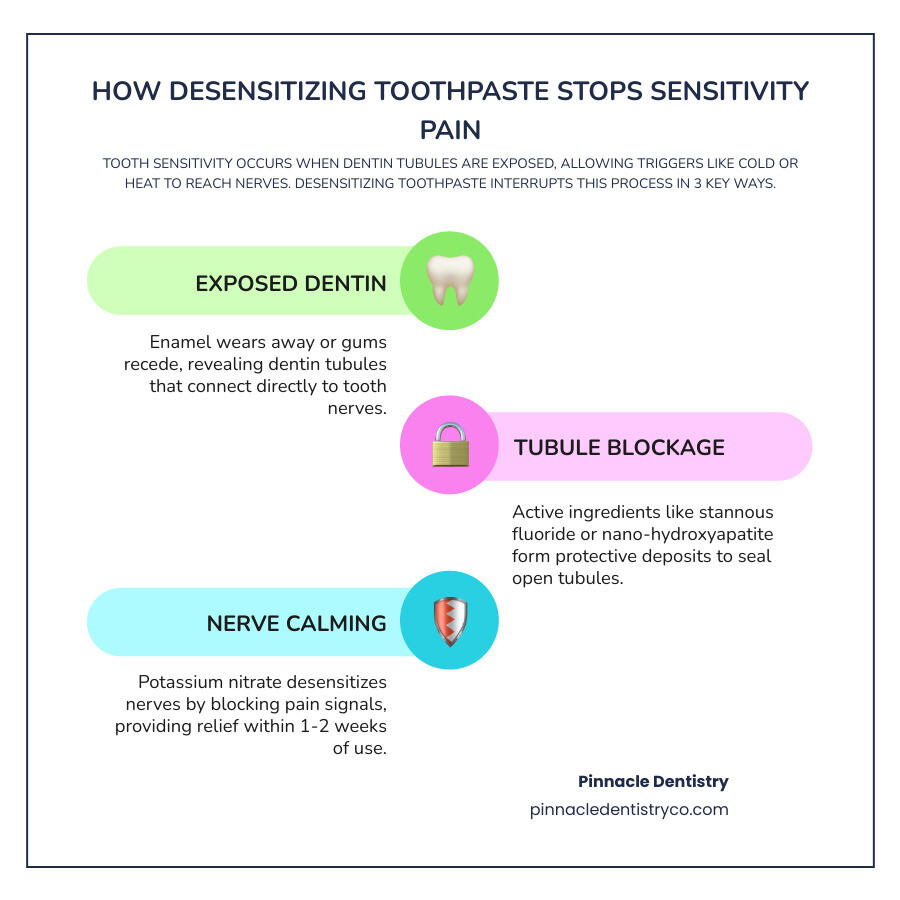
That sharp sting when you sip your morning coffee or bite into something cold? It’s not just annoying, it’s your teeth telling you something. The pain happens when enamel wears down or gums recede, exposing the inner dentin layer and the tiny tubules that connect directly to your tooth’s nerve.
The good news: the right toothpaste can make a real difference. But not all sensitivity toothpastes work the same way, and choosing the wrong one, or using it incorrectly, can slow your results.
I’m Dr. Thomas Jennings, DDS, MAGD, founder of Pinnacle Dentistry and a general dentist with over 35 years of experience helping Colorado Springs families manage tooth sensitivity, including guiding patients toward the most effective desensitizing toothpaste for tooth sensitivity options available today. In this guide, I’ll walk you through everything you need to know, from how these toothpastes work to when it’s time to move beyond the toothpaste aisle.
Understanding the Root Causes of Dental Pain
Before we dive into the solutions, we have to look at why your teeth are shouting at you in the first place. At our Colorado Springs office, we often explain to patients that a healthy tooth is like a well-insulated house. The enamel is your sturdy siding, and the gums are the foundation. When that insulation thins out, the “pipes” inside get frozen, or in this case, shocked.
Enamel Wear and Erosion
Your enamel is the hardest substance in your body, but it isn’t invincible. Over time, it can wear down due to:
- Acidic Foods and Drinks: Frequent consumption of sodas, citrus fruits, and sports drinks can chemically dissolve enamel.
- Aggressive Brushing: Using a hard-bristled brush or “scrubbing” too vigorously can actually sand away your protective layer.
- Teeth Grinding (Bruxism): Many of our patients in Briargate and El Paso County lead busy lives, and stress often manifests as nighttime grinding. This physical friction flattens the biting surfaces and creates micro-cracks.
Gum Recession and Exposed Roots
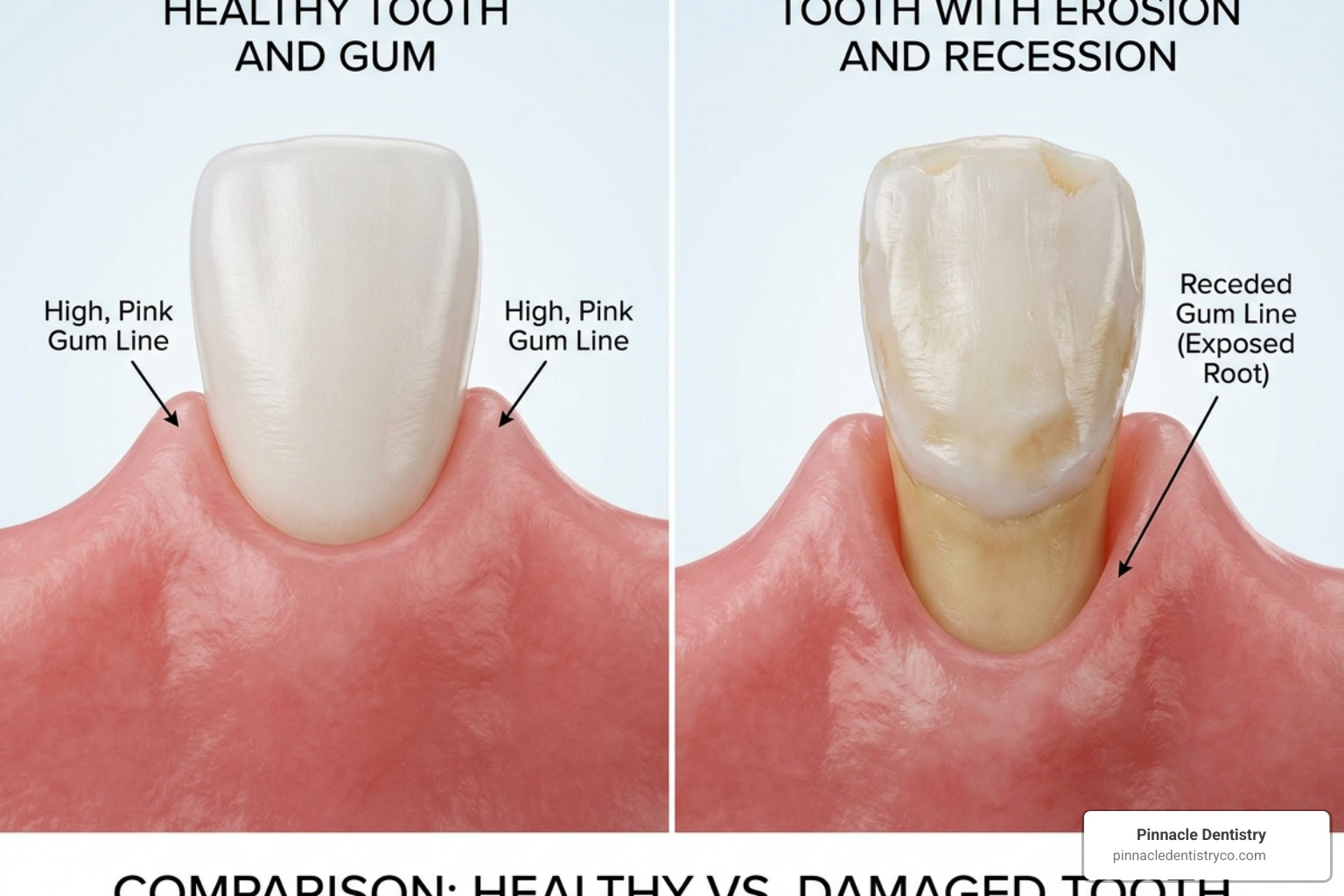
While the crown of your tooth is protected by enamel, the roots are covered by a much softer material called cementum. If your gums recede, whether due to age, gum disease, or genetics, these roots become exposed. Unlike enamel, cementum wears away quickly, leaving the underlying dentin vulnerable.
The Role of Dentin Tubules
Dentin is the layer beneath your enamel. It contains thousands of microscopic channels known as dentin tubules. These tubules lead directly to the pulp chamber, which houses the tooth’s nerve. When hot, cold, or sweet stimuli hit these open channels, the fluid inside moves, triggering a sharp pain response from the nerve. This condition is formally known as tooth sensitivity.
How Desensitizing Toothpaste for Tooth Sensitivity Works
If you’ve ever wondered if that tube of specialty paste is just “regular toothpaste with a higher price tag,” I can assure you the science is quite fascinating. Desensitizing toothpaste for tooth sensitivity works through two primary biological pathways: soothing the nerve or plugging the holes.
Nerve Soothing
Some ingredients work by traveling down those tubules to reach the nerve endings. Once there, they help “calm” the nerve, making it less reactive to triggers like ice cream or hot coffee. It’s essentially like putting a “Do Not Disturb” sign on your tooth’s internal wiring.
Tubule Occlusion (The Barrier Method)
Other formulations take a more structural approach. They contain particles that physically plug or “occlude” the open dentin tubules. By creating a microscopic seal, they prevent the external stimuli from ever reaching the nerve in the first place. This provides lasting protection by rebuilding a protective layer over the vulnerable areas.
For a deeper dive into the terminology, you can explore our glossary entry on desensitizing toothpaste.
Key Active Ingredients and Their Functions
When you’re standing in the oral care aisle in Colorado Springs, the ingredient list can look like a chemistry final. Here is a breakdown of what these ingredients actually do:
| Ingredient | Primary Function | How It Works |
|---|---|---|
| Potassium Nitrate | Nerve Calming | Penetrates tubules to soothe the nerve and block pain signals to the brain. |
| Stannous Fluoride | Tubule Blocking | Creates a sturdy antimicrobial barrier over exposed dentin while fighting cavities. |
| Strontium Chloride | Tubule Blocking | Physically plugs the tubules (though less common in modern formulas than stannous fluoride). |
| Arginine & Calcium | Rapid Occlusion | Uses amino acid technology to seal tubules quickly, often used in “rapid relief” formulas. |
| Nano-Hydroxyapatite | Remineralization | Mimics natural tooth mineral to “fill in” microscopic defects in enamel and dentin. |
Choosing the Best Desensitizing Toothpaste for Tooth Sensitivity
With so many product options for sensitivity, how do you choose? Here are my professional recommendations as an MAGD-certified dentist:
- Look for the ADA Seal: The American Dental Association seal ensures the product has been independently tested for safety and efficacy.
- Check the RDA Value: RDA stands for Relative Dentin Abrasivity. If you have sensitive teeth, you want a “low-abrasive” toothpaste. Some whitening toothpastes are too “gritty” and can actually make sensitivity worse by wearing down more enamel.
- Fluoride is Non-Negotiable: Even if you prefer natural products, fluoride is essential for remineralizing enamel and preventing the cavities that often cause sensitivity in the first place.
- Specific Needs: If you also struggle with gingivitis, look for a formula with stannous fluoride, which treats both sensitivity and gum inflammation.
Best Practices for Maximum Effectiveness
Buying the right desensitizing toothpaste for tooth sensitivity is only half the battle; how you use it matters just as much.
- The Two-Minute Rule: Most people brush for about 45 seconds. For desensitizing agents to work, they need time to interact with your teeth. Aim for a full two minutes, twice a day.
- Soft Bristles Only: We tell all our Colorado Springs patients to throw away their “medium” or “hard” brushes. A soft-bristled brush is the only way to clean effectively without damaging your gums and enamel.
- Spit, Don’t Rinse: After brushing, spit out the excess paste but try not to rinse your mouth with water immediately. Leaving a thin film of the active ingredients on your teeth allows them to continue working long after you’ve left the bathroom.
- Targeted Application: If you have one specific tooth that is driving you crazy, you can apply a small amount of the toothpaste directly to that spot with a clean finger before bed. Think of it as a “sensitivity mask.”
For more detailed advice on maintaining your smile, check out our guide on sensitivity treatment and prevention.
Timeline for Relief and Results
One of the most common questions we get at Pinnacle Dentistry is: “I brushed once, why does it still hurt?”
Sensitivity relief is cumulative. While some “rapid relief” products can show results in as little as three days, most standard desensitizing toothpastes require about two weeks of consistent use to build up enough protection to notice a significant difference.
Think of it like training for a hike at Garden of the Gods, you won’t see the results after one day, but with daily effort, you’ll eventually reach the summit pain-free. If you stop using the toothpaste, the protection will gradually wash away, so consistent usage is key for 24/7 protection.
When to Transition from Home Care to Professional Treatment
While desensitizing toothpaste for tooth sensitivity is a fantastic first line of defense, it isn’t a cure-all. Sometimes, sensitivity is a “red flag” for a deeper issue that no amount of toothpaste can fix.
You should schedule an appointment with us if:
- The pain is localized: If only one specific tooth hurts, it could be a cracked tooth or a failing filling.
- The pain is spontaneous: If your tooth throbs without any trigger (like cold or heat), the nerve may be infected.
- You see visible changes: If you notice a hole, a dark spot, or a significant “notch” near the gum line.
- No improvement: If you’ve used sensitivity toothpaste for four weeks and still can’t enjoy a cold drink.
Professional Treatments Beyond Desensitizing Toothpaste for Tooth Sensitivity
As MAGD-certified dentists, a distinction held by less than 2% of general dentists, we offer advanced clinical options for tooth sensitivity that go beyond over-the-counter fixes:
- Fluoride Varnishes: A highly concentrated fluoride treatment applied in-office that strengthens enamel and “deep freezes” sensitivity.
- Dental Bonding or Sealants: We can apply a tooth-colored resin to cover exposed roots or deep grooves, providing an instant physical barrier.
- Surgical Gum Grafts: If gum recession is severe, a specialist can protect the roots by grafting new tissue over the area.
- Custom Mouthguards: For our patients who grind their teeth, a custom-fitted nightguard prevents further enamel wear and allows the teeth to “rest.”
- Root Canal Therapy: In extreme cases where the nerve is permanently damaged or inflamed, a root canal may be necessary to remove the source of the pain entirely.
Frequently Asked Questions
How long does it take for desensitizing toothpaste to work?
As mentioned, most people experience significant relief within 7 to 14 days. However, some formulas containing arginine or stannous fluoride may offer “rapid relief” within just a few applications. For the best results, use it twice daily without skipping.
Are there any side effects to using sensitivity toothpaste?
For the vast majority of people, these toothpastes are perfectly safe. However, some individuals may experience “sloughing,” where the thin skin inside the cheeks peels slightly. This is often a reaction to Sodium Lauryl Sulfate (SLS), the ingredient that makes toothpaste foam. If this happens, look for an SLS-free sensitivity toothpaste.
Do natural or fluoride-free desensitizing toothpastes actually work?
Yes, particularly those containing nano-hydroxyapatite. This ingredient is a biocompatible mineral that effectively remineralizes teeth and blocks tubules. While they can be effective for sensitivity, we still recommend fluoride-containing products for their superior cavity-fighting abilities, especially for patients with exposed roots which are highly prone to decay.
Conclusion
Living with tooth sensitivity can take the joy out of simple things, like a summer ice cream cone or a hot cup of tea on a snowy Colorado morning. Desensitizing toothpaste for tooth sensitivity is a proven, effective tool that provides relief for millions of people.
At Pinnacle Dentistry, our goal is to provide more than just a quick fix. Our MAGD-certified dentists take a personalized approach to your oral health, ensuring we don’t just treat the symptoms, but address the root cause of your discomfort. Whether you need a simple product recommendation or advanced restorative care, we are here to help our neighbors in Colorado Springs, Briargate, and El Paso County smile comfortably.
Don’t let sensitive teeth dictate your diet or your comfort. Schedule your consultation for desensitizing toothpaste guidance today and take the first step toward a pain-free smile.