
Understanding the Signs and Symptoms of TMJ Disorders
The signs and symptoms of TMJ disorders can range from a mild jaw ache to debilitating facial pain that affects eating, sleeping, and daily life. Here is a quick overview of the most common ones:
Most Common Signs and Symptoms of TMJ Disorders:
- Jaw pain or tenderness, especially near the ear
- Clicking, popping, or grating sounds when opening or closing the mouth
- Difficulty or pain while chewing
- Locking of the jaw joint, including difficulty opening or closing fully
- Aching pain in or around the ear
- Headaches, often felt at the temples
- Neck or shoulder pain
- Facial aching or fatigue
- Ringing in the ears, known as tinnitus, or a feeling of ear fullness
- Limited range of jaw motion
According to clinical research, the most common presenting symptoms are facial pain, ear discomfort, headache, and jaw discomfort or dysfunction. TMD affects many adults in the United States, yet only a small fraction seek treatment.
What makes TMJ disorders tricky is that many of these symptoms show up far from the jaw itself. Headaches, ear pain, and neck tension are frequently mistaken for unrelated conditions, which means the real source of the problem often goes unaddressed for months or even years.
Our experienced dental team in Colorado Springs, CO, helps patients recognize the full range of signs and symptoms of TMJ disorders and determine when a professional evaluation may be appropriate. In this guide, we explain what your jaw may be telling you and practical next steps for protecting your comfort.
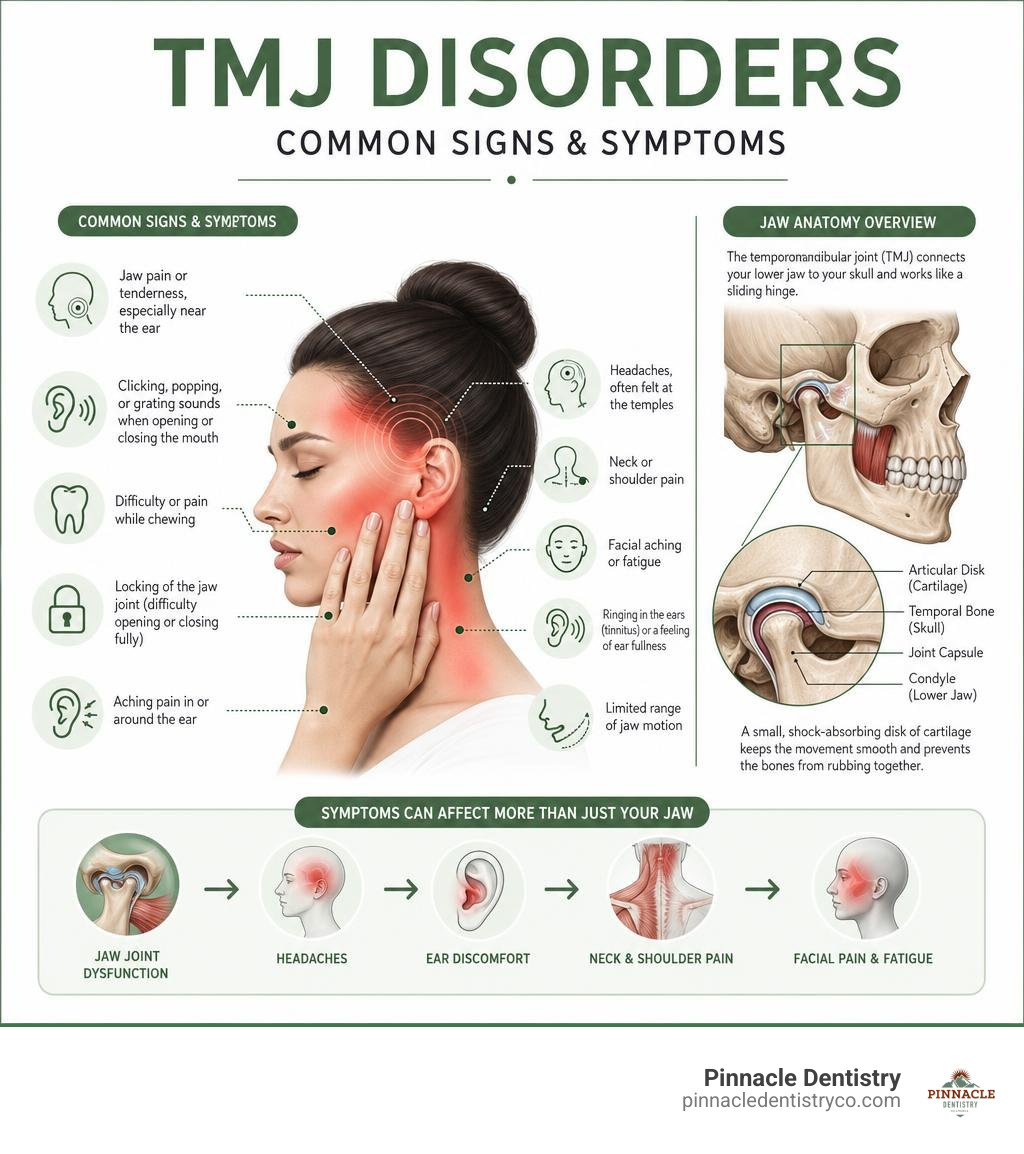
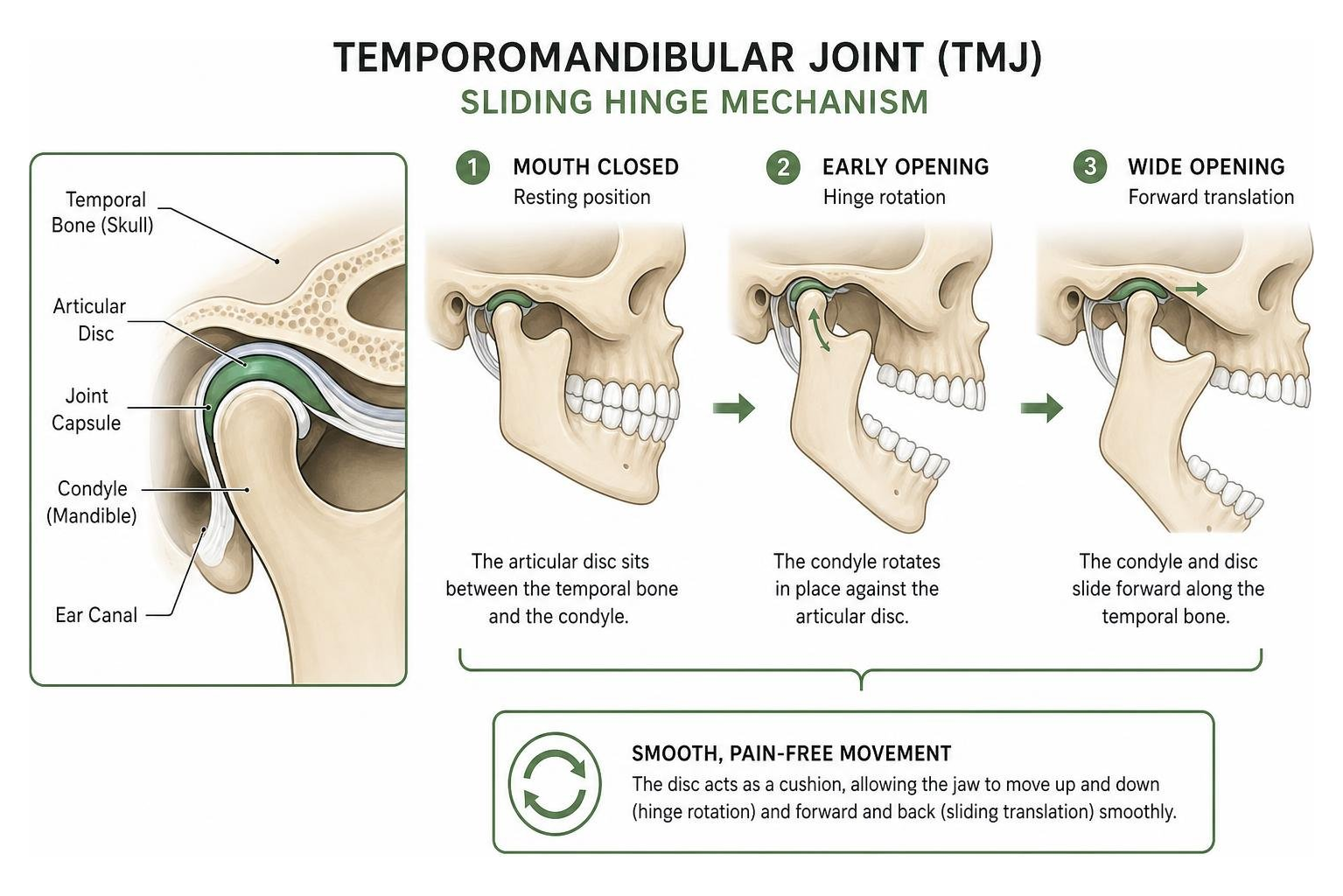
To understand how a tiny joint can cause such widespread discomfort, we have to look at how the jaw is built. The temporomandibular joint is one of the most complex, hard-working joints in the human body. Located on each side of your head just in front of your ears, these joints act as sliding hinges that connect your lower jawbone to your skull.
Because this joint allows your jaw to move up and down, side to side, and forward and backward, it is constantly in motion. We use it to talk, chew, swallow, yawn, and even express emotions. Inside each joint, a small, shock-absorbing disk made of cartilage keeps the movement smooth and prevents the bones from rubbing directly against each other.
When this delicate balance is disrupted, a group of conditions known as temporomandibular disorders, or TMD, can develop. While people often use “TMJ” to refer to both the joint and the problem, TMJ is the anatomical joint, whereas TMD is the actual medical condition.
According to a comprehensive clinical review of TMD symptoms, these disorders are highly multifactorial. They can stem from direct joint issues, such as a displaced disk or arthritis, or they can originate in the surrounding muscles that control jaw movement. When the muscles or joints are inflamed, the pain rarely stays put. It radiates outward, causing facial pain, deep ear discomfort, and general jaw dysfunction that makes everyday activities feel like a chore.
Primary Signs and Symptoms of TMJ Disorders in the Jaw
The most obvious signs and symptoms of TMJ disorders occur right at the source. If you are dealing with TMD, your jaw joints and the muscles around them will often let you know through several distinct physical signs:
- Jaw Clicking and Joint Popping: Many people notice a distinct clicking, popping, or grating sound when they open their mouth to eat or speak. This sound can occur when the shock-absorbing disk slips out of its proper position and then returns as the jaw moves.
- Jaw Locking: In more severe cases, the jaw can get stuck. It may lock in an open position, or more commonly, lock closed, making it difficult to open your mouth fully. This can be associated with disk displacement and should be evaluated by a dental professional. In advanced situations, when TMJ surgery is necessary can become part of the conversation, although conservative therapies are generally considered first.
- Limited Range of Motion: You might find that you cannot open your mouth as wide as you used to. Simple tasks like biting into a sandwich, yawning, or brushing your back teeth can suddenly feel restricted and uncomfortable.
If you notice these direct issues, the signs of TMJ disorder can help you recognize changes in daily jaw function.
For persistent pain, stiffness, or locking, TMJ therapy can begin with a careful evaluation and conservative treatment options tailored to your needs.
Secondary Signs and Symptoms of TMJ Disorders Beyond the Jaw
Because the nerves supplying the jaw joint are closely linked to other areas of the head, neck, and face, TMD can cause referred pain. This means your brain registers pain in one area even though the actual problem is located in your jaw.
Common secondary symptoms include:
- Tension Headaches: TMJ headaches often mimic tension headaches or migraines. They typically feel like a dull, aching band of pressure across the forehead or concentrated at the temples. This happens because the temporalis muscle, which runs along the side of your head, is directly involved in clenching and chewing.
- Ear Fullness and Tinnitus: Many patients visit an ear, nose, and throat specialist believing they have a deep ear infection. They report earaches, a clogged sensation, or persistent ringing in the ears, known as tinnitus. Because the jaw joint sits directly next to the ear canal, inflammation in the TMJ can mimic ear-related issues.
- Neck and Shoulder Pain: The muscles of the jaw, neck, and upper back work together to support your head posture. When jaw muscles are chronically tight and fatigued, they can contribute to chronic stiffness, shoulder tension, and poor posture.
If you have been struggling with unexplained head or neck pain, the connection between TMJ pain and referred symptoms can help you connect the dots between your jaw and overall comfort.
Normal Jaw Sounds vs. TMD Indicators
It is common to hear a slight click or pop in your jaw from time to time. Research indicates that many people experience joint sounds without pain or functional issues. So, how do you know when a jaw sound is a harmless quirk versus a sign of a developing disorder?
The primary dividing line is pain and dysfunction. If your jaw clicks when you yawn but it does not hurt, and you can open your mouth fully without stiffness, it is generally considered asymptomatic clicking. In these cases, active treatment may not be needed.
However, if that popping is accompanied by a sharp or dull ache, if it occurs every time you chew, or if your jaw feels stiff afterward, it may indicate TMD. Another sound to watch for is crepitus, a dry, crunching, or grating sound similar to walking on gravel. Crepitus can be associated with joint changes and should be evaluated in the context of your symptoms and jaw function.
The National Institute of Dental and Craniofacial Research’s overview of TMD notes that joint sounds alone do not necessarily require invasive treatment. A dental professional should consider the complete clinical picture, including comfort, muscle tenderness, and overall jaw mobility, before recommending therapy.
Early Warning Signs and Common Triggers
Catching a TMJ issue in its earliest stages can help prevent it from developing into a chronic, painful condition. Many patients do not realize that their everyday habits and stress levels are actively taxing their jaw joints.
One early warning sign is waking up with morning jaw stiffness or a dull headache. This can be associated with nocturnal bruxism, the subconscious grinding or clenching of teeth during sleep. Sleeping on your stomach can also place uneven pressure on the jaw joint throughout the night and worsen morning symptoms.
Common lifestyle triggers that place unnecessary strain on the TMJ include:
- Chronic Stress and Anxiety: High stress levels can make daytime clenching more likely, often without you realizing it.
- Repetitive Habits: Chewing ice, biting fingernails, chewing pens, or constantly chewing gum forces the jaw joints to work without adequate rest.
- Using Teeth as Tools: Opening packages, tearing tape, or holding items with your teeth places unnatural torque on the jaw joints.
Understanding what sets off your discomfort is essential for long-term management. By identifying the causes of TMJ pain, you can take proactive steps to adjust daily habits and protect your smile.
When symptoms continue despite habit changes, common TMJ treatment options can help you understand the conservative care a dental team may recommend.
When to Seek Professional Medical and Dental Attention
While minor jaw soreness can sometimes resolve on its own with simple home care, there are several “red flag” situations that require professional evaluation. You should schedule an appointment with a qualified dental professional if you experience persistent jaw pain that does not improve after a few weeks, if you have difficulty swallowing or chewing, or if your jaw locks completely.
At Pinnacle Dentistry, our team of certified MAGD dentists, an elite distinction held by less than 2% of dentists nationwide, uses advanced diagnostics to evaluate your joint function. We will carefully listen to your jaw, map its range of motion, and look for signs of wear on your teeth.
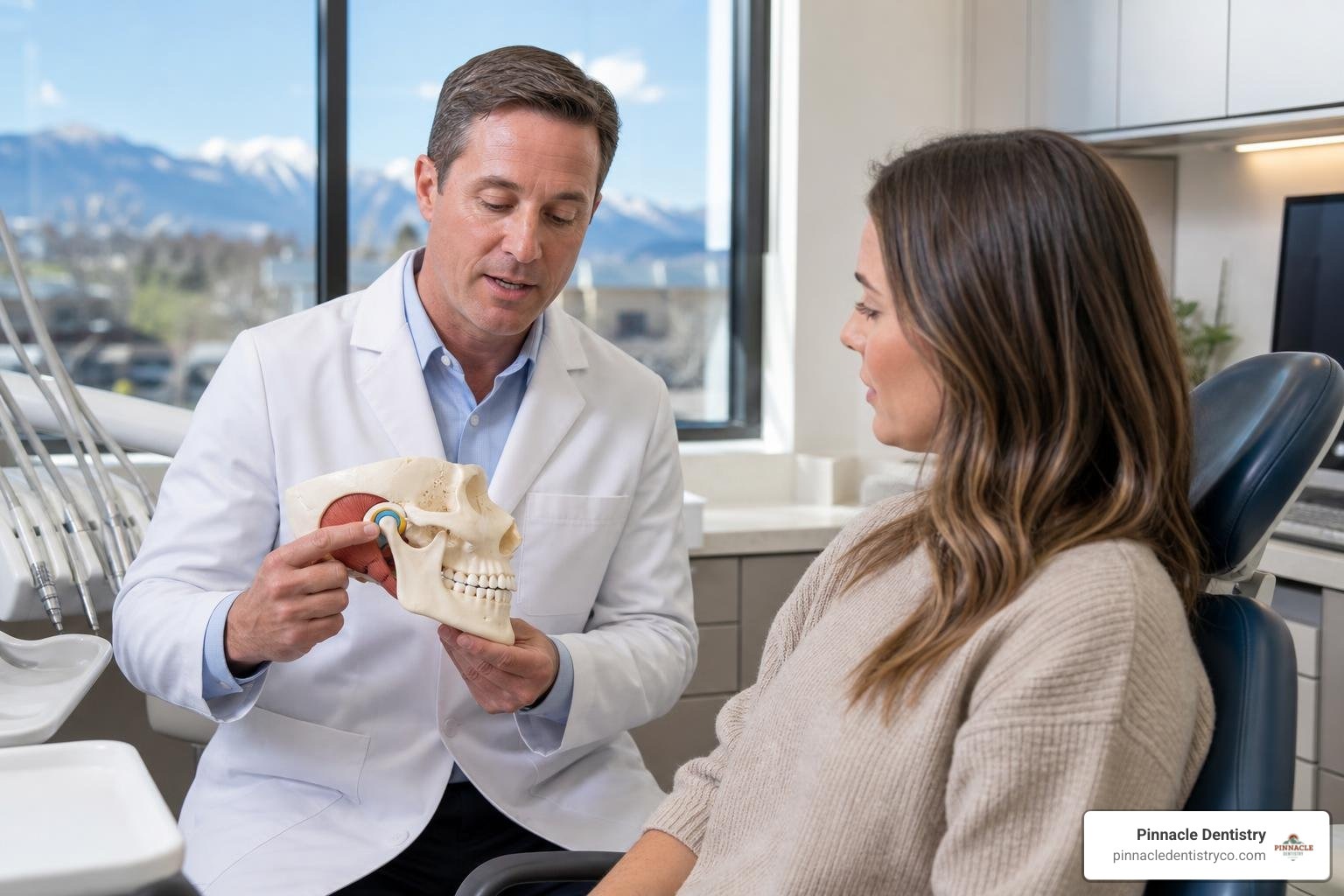
When you visit us, we often perform a simple clinical evaluation and refer to established Mayo Clinic clinical protocols to ensure an accurate, highly personalized diagnosis. We also coordinate with local physical therapists and specialists in El Paso County, CO to provide a holistic approach to your recovery. If you are wondering who is best equipped to handle your jaw pain, check out our guide on who to see for TMJ to find the right path forward.
Frequently Asked Questions About TMJ Disorders
What is the difference between TMJ and TMD?
TMJ refers strictly to the physical structure of the temporomandibular joint itself, the actual sliding hinge on either side of your jaw. TMD stands for temporomandibular disorders, which is the medical term for the group of conditions, muscle spasms, and joint issues that cause pain and dysfunction in that area.
Can TMJ symptoms resolve on their own?
Yes, up to 40% of patients experience spontaneous resolution of mild TMJ symptoms without any medical intervention. For many others, simple, conservative home care, such as eating soft foods, practicing stress reduction, and applying moist heat, can successfully resolve a flare-up within a few weeks.
How do I perform the three-finger mobility test at home?
To check your jaw mobility, try to hold your index, middle, and ring fingers together vertically and place the tips between your front teeth. A normal, healthy jaw opening is typically about 40 millimeters, which is wide enough to comfortably fit all three fingers without forcing your jaw or feeling pain. If you can only fit one or two fingers, your range of motion may be restricted by TMD.
Does stress make TMJ disorders worse?
Absolutely. Stress is one of the most common triggers for TMJ flare-ups. When you are stressed or anxious, your body naturally holds tension in your shoulders, neck, and jaw. This often leads to subconscious daytime clenching and increased nighttime teeth grinding, which severely fatigues the chewing muscles.
Are custom nightguards better than over-the-counter mouthguards?
Yes, custom nightguards are significantly better and safer. Over-the-counter boil and bite guards are often soft and bulky, which can actually encourage you to chew and clench down harder at night, worsening your muscle pain. A custom-crafted nightguard from a dentist is made of durable, hard acrylic designed to precisely align your bite, distribute pressure evenly, and allow your jaw joint to rest in its natural position.
Can a bad bite or orthodontic braces cause TMD?
No. Modern scientific and clinical research does not support the belief that a misaligned bite, known as malocclusion, or orthodontic braces cause TMJ disorders. TMD is a complex, multifactorial condition driven primarily by genetics, stress, muscle tension, and joint anatomy rather than simple tooth alignment.
Why does TMJ cause ear pain and ringing in the ears?
The jaw joint sits directly adjacent to the tympanic membrane and ear canal. Additionally, certain middle ear structures and the muscles of mastication share the same embryological origin and nerve pathways. When your jaw muscles spasm or the joint becomes inflamed, the pain signals travel along the same nerves, creating the sensation of an earache, fullness, or ringing in the ears.
What are the best home remedies for acute TMJ flare-ups?
For immediate relief, switch to a soft food diet, cut your food into small pieces, and avoid chewing gum. Apply an ice pack wrapped in a cloth for 15 minutes to reduce acute inflammation, or use warm, moist heat to relax tight, aching muscles. Practice resting your tongue gently against the roof of your mouth with your teeth apart and your lips closed to keep your jaw in a relaxed posture.
When is surgery necessary for TMJ disorders?
Surgery is considered a last resort and is only necessary for a tiny fraction of patients, roughly 5% to 10%. It is reserved for severe cases involving structural joint destruction, severe arthritis, or a completely locked jaw that has failed to respond to all conservative, non-invasive treatments.
How is a TMJ disorder officially diagnosed?
An official diagnosis is made through a comprehensive physical examination. Your provider will listen to and feel your jaw as you open and close your mouth, measure your range of motion, and press on your facial muscles to locate areas of tenderness. If needed, imaging studies such as digital X-rays, 3D cone beam computed tomography, or an MRI may be ordered to visualize the bones and the soft cartilage disk.
Conclusion
Living with the signs and symptoms of TMJ disorders can be exhausting, but you do not have to navigate this journey alone. Many patients find meaningful relief through conservative, reversible treatment approaches. From custom-fitted dental appliances that protect teeth to targeted physical therapy and lifestyle modifications, the right plan can help you work toward a more comfortable daily life.
At Pinnacle Dentistry in Colorado Springs, CO, we are dedicated to helping our neighbors in Briargate, CO, and across El Paso County, CO find comfortable, long-term solutions for jaw pain. Our certified MAGD dentists provide personalized, advanced care in a warm and welcoming environment.
If you are ready to stop guessing what your jaw is trying to tell you and start feeling like yourself again, contact our TMJ therapy specialists to schedule an appointment. We look forward to helping you smile, chew, and live with greater confidence.