
Does Insurance Cover Veneers? Here’s What You Need to Know First
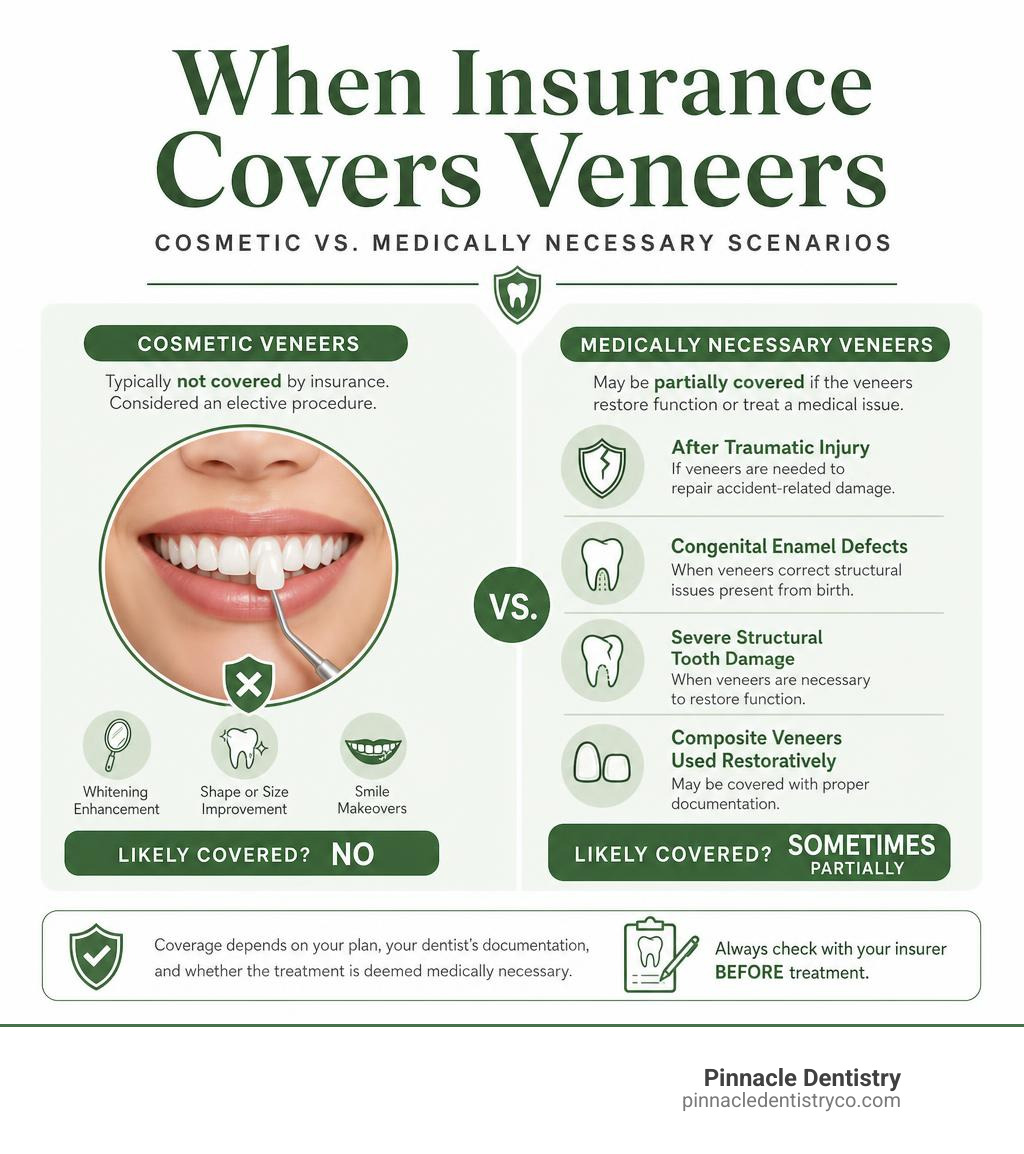
Does insurance cover veneers in most cases? The short answer is no. Here is a quick breakdown:
| Situation | Likely Covered? |
|---|---|
| Veneers for cosmetic reasons (whitening, shape) | No |
| Veneers after traumatic injury | Sometimes |
| Veneers for congenital enamel defects | Sometimes |
| Veneers for severe structural tooth damage | Sometimes |
| Composite veneers used restoratively | Possibly, with documentation |
Most dental insurance plans classify veneers as a cosmetic procedure, which puts them in the same category as teeth whitening or elective smile makeovers. That means most plans pay nothing toward the cost. However, there are real exceptions. If a veneer is restoring a tooth damaged by an accident, significant decay, or a congenital condition, your insurer may cover a portion of the cost, typically around 40 to 50 percent, after your deductible.
The tricky part is that coverage depends heavily on your specific plan, how your dentist documents the treatment, and whether you take the right steps before treatment begins. Pricing can also vary depending on several factors, so it pays to understand the full picture before you sit in the dental chair.
I’m Dr. Thomas Jennings, DDS, MAGD, founder of Pinnacle Dentistry in Colorado Springs, CO, and I’ve spent over 35 years helping patients navigate the often confusing question of does insurance cover veneers while guiding them toward the best clinical and financial outcomes. In this guide, I’ll walk you through everything you need to know so you can make a confident, informed decision for yourself and your family.
What Are Dental Veneers and How Much Do They Cost?
Dental veneers are ultra-thin, custom-made shells crafted from tooth-colored materials that bond directly to the front surfaces of your teeth. They are designed to cover imperfections such as deep stains, chips, minor misalignment, or uneven spacing, instantly transforming your smile.
When considering this smile makeover, understanding the financial investment is an important first step. The overall cost of veneers can vary depending on several factors, including the material chosen, the complexity of your case, and the number of teeth being treated. Because veneers are customized to match the unique contours of your mouth, the price reflects the highly detailed laboratory work and clinical expertise required to achieve a natural, beautiful result.
What are porcelain veneers and the benefits include unmatched durability and stain resistance, making them a premier choice for long-term smile enhancement. While the upfront investment for high-quality materials is typically higher than other cosmetic treatments, their long lifespan and natural appearance often make them the most cost-effective solution over time.
| Veneer Type | Lifespan | Typical Enamel Preparation | Relative Cost |
|---|---|---|---|
| Porcelain | 10 to 20 years | Moderate (approx. 0.5mm) | Higher |
| Composite Resin | 5 to 7 years | Minimal | Moderate |
| No-Prep (Lumineers) | 10 to 20 years | None to Ultra-Minimal | Premium |
Porcelain vs. Composite vs. No-Prep Veneers
Choosing the right type of veneer is a balance between your aesthetic goals, your budget, and how much natural tooth structure you wish to preserve.
- Porcelain Veneers: These are the gold standard in cosmetic dentistry. Made from high-grade ceramic, porcelain veneers mimic the light-reflecting properties of natural enamel beautifully. They are highly resistant to stains from coffee, tea, and tobacco. However, placing them is an irreversible process because we must remove a tiny layer of enamel (about 0.5 millimeters) to ensure the veneer sits flush with your gumline. You can explore our porcelain veneers services to see how we customize these restorations for a seamless fit.
- Composite Resin Veneers: Made from the same tooth-colored material used for dental bonding, composite veneers are sculpted directly onto your teeth (often in a single visit) or fabricated in a dental lab. They require less enamel removal and are generally more budget-friendly upfront. However, they are more prone to staining, chipping, and wear, meaning they will need to be replaced much sooner than porcelain.
- No-Prep Veneers (such as Lumineers): These ultra-thin laminate shells (around 0.2 millimeters) require little to no enamel removal. Because your natural teeth remain intact, the procedure is often reversible. They are durable, but because they are placed over the existing enamel, they may not be suitable for severely misaligned or deeply discolored teeth, as they can sometimes look slightly bulky if not planned precisely.
Factors That Influence the Cost of Veneers
When you receive a treatment plan for veneers, the total price is influenced by several distinct variables:
- Geographic Location: Dental fees reflect the local cost of living and business overhead. For instance, receiving cosmetic dental care in Colorado Springs, CO, or the surrounding El Paso County, CO area will have different pricing dynamics compared to major coastal metropolitan areas.
- Dentist’s Expertise: Highly trained dentists, such as those who have achieved Mastership in the Academy of General Dentistry (MAGD), a rare credential held by less than 2% of general dentists nationwide, bring specialized clinical skill to the planning and placement of veneers. This advanced training ensures a safer, more precise, and highly aesthetic result.
- Number of Teeth Treated: While some patients only need a single veneer to correct a chipped tooth, most smile makeovers involve treating the “social six” or “social eight” upper teeth that show when you smile.
- Preparatory Work: Your teeth and gums must be healthy before cosmetic work begins. If we discover active tooth decay or periodontal disease during your initial exam, these issues must be treated first, which can affect your overall treatment plan and timeline. Understanding the cost of cosmetic dentistry veneers bonding helps clarify how these preparatory steps lay the necessary foundation for a successful, long-lasting transformation.
Does Insurance Cover Veneers? Cosmetic vs. Medically Necessary
The fundamental rule of dental insurance is simple: plans are designed to maintain oral health and restore essential function, not to pay for elective cosmetic enhancements. Because veneers are primarily used to improve the appearance of your smile, standard policies almost always exclude them under a strict “cosmetic exclusion” clause.
However, the line between cosmetic and restorative dentistry can occasionally blur. If a tooth is structurally compromised, a veneer may serve a dual purpose: restoring the tooth’s physical integrity while also improving its look. When a treatment is deemed medically necessary to restore chewing function or prevent further dental deterioration, your insurance policy may cover a portion of the procedure. To understand how major providers handle these distinctions, you can consult the Veneers: Cost and Insurance Coverage resource from Delta Dental.
Key Exceptions: When Does Insurance Cover Veneers?
There are specific clinical scenarios where dental insurance companies may agree to pay for veneers:
- Traumatic Injury: If you are involved in an accident, a fall, or a sports injury that fractures or severely chips your front teeth, your insurance may cover veneers as a restorative treatment to rebuild the broken teeth.
- Severe Decay or Structural Failures: When a tooth has a large cavity or has undergone a root canal, its structural integrity is weakened. While a full crown is the traditional solution, a veneer is sometimes considered a more conservative, enamel-saving alternative that qualifies for restorative coverage.
- Congenital Conditions and Developmental Defects: Genetic conditions such as enamel hypoplasia (underdeveloped enamel) or severe amelogenesis imperfecta can leave teeth highly sensitive, prone to decay, and structurally weak. In these cases, veneers are medically necessary to protect the exposed dentin. For federal employees or those with comprehensive benefits, checking the Dental Veneers guidelines from Blue Cross Blue Shield FEP Dental can reveal specific criteria for congenital coverage.
How to Determine: Does Insurance Cover Veneers Under Your Plan?
Determining whether your specific plan offers any loophole for veneer coverage requires a bit of detective work.
Start by obtaining your Summary Plan Description or Evidence of Coverage document. Look closely at the exclusions section for terms like “cosmetic procedures,” “elective treatments,” or “veneers.”
Next, look at the specific dental codes. In the dental industry, procedures are billed using CDT (Current Dental Terminology) codes. The standard codes for veneers are:
- D2962: Lab-processed porcelain laminate veneers.
- D2963: Resin (composite) laminate veneers.
If your dentist submits these codes with a narrative explaining that the treatment is purely cosmetic, the claim will be denied automatically. However, if the veneers are being placed to restore structurally damaged teeth, your dentist can submit clinical evidence (such as X-rays, photos, and a diagnostic narrative) to support a restorative claim. To learn more about navigating these complex policy structures, take a look at our guide on everything you need to know about dental benefits.
Navigating Dental Insurance Plans and Coverage Limits

Understanding the structure of your dental plan is essential when planning for any major dental work. Different plan types offer vastly different levels of flexibility, and they all come with built-in limitations that can affect your out-of-pocket expenses.
PPO vs. HMO vs. Dental Discount Plans
The type of dental plan you hold dictates where you can receive care and how much of the bill you will carry:
- PPO (Preferred Provider Organization) Plans: PPOs are the most popular and flexible plans. They allow you to see any licensed dentist, though you will save more by choosing an in-network provider. If your PPO plan does cover restorative veneers, they are typically classified as a “Major Service,” meaning the plan will pay approximately 50% of the allowed fee after you meet your deductible.
- HMO (Health Maintenance Organization) / DMO Plans: These plans require you to receive care exclusively from a primary care dentist within a restricted network. While monthly premiums are low, HMOs rarely cover cosmetic treatments or offer out-of-network benefits, making them highly restrictive if you are seeking a specialized cosmetic dentist for veneers.
- Dental Discount Plans: These are not traditional insurance plans but rather annual membership programs. In exchange for a yearly fee, participating dentists agree to offer discounted rates (often 15% to 20% off) on all services, including purely cosmetic procedures like veneers. If you want to dive deeper into how these structures operate, our overview of dental benefits provides a clear breakdown.
Maximizing Your Annual Benefits and Handling Denials
Even if your PPO insurance agrees to cover restorative veneers, you must navigate your policy’s annual maximum benefit. Most traditional dental plans cap their yearly payout between $1,000 and $2,500. Because a full set of veneers is a significant investment, the cost will quickly exceed this cap.
To maximize your benefits, we often recommend a strategy of splitting your treatment across two calendar years. For example, if you are treating six front teeth, we can prepare and place the first three in November or December, utilizing your current year’s maximum, and complete the remaining three in January, tapping into your renewed annual benefit. For more tips on timing your care, read about the 5 reasons to use your dental benefits before the end of the calendar year.
Before starting any veneer treatment, we highly recommend requesting a Pre-Determination of Benefits from your insurer. We will submit your X-rays, intraoral photos, and a detailed clinical narrative to your insurance company. Within two to four weeks, the insurer will send back an official statement detailing exactly what they will cover and what your estimated out-of-pocket responsibility will be, protecting you from unexpected financial surprises.
Alternative Payment Options and Cost-Saving Strategies
If your insurance plan completely excludes veneers, do not despair. There are several highly effective strategies to manage the cost of your smile transformation without sacrificing clinical quality.
- HSA and FSA Accounts: Health Savings Accounts (HSAs) and Flexible Spending Accounts (FSAs) allow you to set aside pre-tax dollars for medical and dental expenses. Using these accounts to pay for your veneers can effectively save you 22% to 37% (depending on your tax bracket) on your out-of-pocket costs. While HSAs can generally be used for any dental treatment, some FSAs require a medical necessity letter from your dentist to approve cosmetic procedures.
- In-House Wellness and Savings Plans: Many modern dental practices offer in-house membership plans for patients who do not have traditional insurance. These plans typically cover your bi-annual cleanings and exams completely while providing a flat discount (usually 15% to 20%) on all other treatments, including cosmetic dentistry.
- Flexible Third-Party Financing: Companies like CareCredit or Cherry offer specialized healthcare credit lines. Many of these programs feature 0% interest promotional periods ranging from 6 to 24 months, allowing you to break your treatment cost down into manageable monthly payments.
- Dental Schools: If you live near a university with an accredited dental program, you can receive treatment from supervised dental students at a significantly reduced rate. While this is a budget-friendly option, keep in mind that treatments take much longer because every step must be meticulously reviewed by a board-certified faculty dentist.
If you are currently navigating your options without a traditional policy, our guide on what if I don’t have dental benefits offers practical steps to keep your dental health on track.
Frequently Asked Questions About Veneer Insurance Coverage
1. Is there any dental insurance that covers veneers for cosmetic reasons?
No. Standard dental insurance plans are designed strictly to cover preventive, basic, and major restorative services that maintain or restore oral health. Because cosmetic veneers are considered elective procedures to improve appearance, they are universally excluded from standard coverage.
2. How much do veneers cost out of pocket with insurance?
If your insurance plan does not cover veneers, you will be responsible for 100% of the cost. If your dentist successfully documents the veneers as medically necessary (restorative), your PPO plan may cover up to 50% of the allowed fee, leaving you responsible for the remaining balance, deductibles, and any costs exceeding your annual maximum benefit.
3. Will dental insurance cover replacing a chipped or broken veneer?
Insurance will only consider covering a replacement veneer if the original veneer was covered as a restorative treatment and has met your policy’s frequency limitation rule (which typically dictates that a restoration can only be replaced once every 5 to 10 years). If the veneer was placed for cosmetic reasons, any subsequent repairs or replacements must be paid entirely out of pocket.
4. Can I use my HSA or FSA to pay for porcelain veneers?
Yes, you can use your HSA or FSA funds to pay for veneers. However, because the IRS technically prohibits using tax-advantaged accounts for purely elective cosmetic procedures, it is highly recommended to have your dentist write a letter of medical necessity explaining how the veneers restore structural damage or prevent decay.
5. What dental code is used for medically necessary veneers?
The standard CDT billing codes for veneers are D2962 (for lab-processed porcelain or ceramic laminate veneers) and D2963 (for resin or composite laminate veneers). These are the codes your dental office will submit along with supporting clinical documentation to request restorative coverage.
6. Is dental bonding covered by insurance if veneers are not?
Yes, dental bonding is often covered by insurance because it is frequently used to treat active decay or structural damage. Bonding is classified as a basic restorative service and is typically covered at 70% to 80% under most PPO plans, making it a highly cost-effective alternative to veneers.
7. Do dental savings plans offer discounts on cosmetic veneers?
Yes. Unlike traditional insurance plans, dental savings (discount) plans do not have cosmetic exclusions, waiting periods, or annual maximums. Participating dentists agree to offer a set discount, usually between 15% and 20%, on all cosmetic procedures, including veneers, for members.
8. How do I appeal an insurance denial for restorative veneers?
To appeal a denial, your dental office must submit a formal appeal letter alongside comprehensive clinical evidence. This includes pre-treatment X-rays, high-resolution intraoral photographs showing the structural damage, and a detailed diagnostic narrative from your dentist explaining why a veneer was required to restore function.
9. Are no-prep veneers cheaper and covered by dental insurance?
No-prep veneers (such as Lumineers) are made from highly specialized, ultra-thin porcelain and require advanced clinical precision, meaning their laboratory and placement costs are often similar to or higher than traditional porcelain. Like traditional veneers, they are classified as cosmetic and are not covered by insurance unless restorative necessity is proven.
10. Does state Medicaid or Medicare cover dental veneers?
No. State Medicaid programs and standard Medicare plans only cover essential, emergency, or highly basic dental services for adults. Cosmetic procedures, including veneers, are completely excluded from these government-sponsored healthcare programs.
Conclusion

Navigating the financial side of cosmetic dentistry can feel overwhelming, but you do not have to do it alone. While the answer to does insurance cover veneers is often a disappointing “no” for elective makeovers, understanding the restorative exceptions, utilizing pre-determination benefits, and exploring tax-advantaged accounts like HSAs can unlock surprising savings.
The most important step in your smile journey is choosing a dental team you can trust. At Pinnacle Dentistry in Colorado Springs, CO, our certified MAGD dentists are dedicated to providing personalized, world-class care that fits your lifestyle and your budget. We will work closely with you to design a customized treatment plan, maximize your available benefits, and guide you through our flexible financial options so you can achieve the healthy, radiant smile you deserve.
If you are ready to take the first step toward a more confident smile, we invite you to contact us at our Briargate, CO office at 2430 Research Pkwy Suite 200, Colorado Springs, CO 80920, and book an appointment for our comprehensive dental services today!
