


What Is Sedation and Analgesia? A Clear Guide for Patients and Families
Sedation and analgesia work together to keep patients comfortable and pain-free during medical and dental procedures. Here is a quick overview:
- Sedation reduces anxiety and awareness, ranging from mild relaxation to full unconsciousness
- Analgesia refers specifically to pain relief, without necessarily causing sedation
- Together, they allow patients to undergo procedures they could not otherwise tolerate while awake
- There are four main levels: minimal sedation, moderate sedation, deep sedation, and general anesthesia
- Providers select the right level based on the procedure, patient health, and safety factors
Whether you are preparing for a routine dental procedure or helping a family member through a more complex medical visit, understanding how sedation works can make the experience far less intimidating. Many people feel uncertain about what to expect, what the risks are, and who is responsible for their safety during the process. That uncertainty is completely normal.
Sedation exists on a continuum. According to the American Society of Anesthesiologists, a patient can move from one level to a deeper one faster than expected, which is why trained providers always stay prepared to manage whatever level a patient reaches. The goal is always the same: keep you comfortable, keep you safe, and keep the procedure moving smoothly.
I am Dr. Thomas Jennings, DDS, MAGD, founder of Pinnacle Dentistry in Colorado Springs, CO, with over 35 years of experience incorporating sedation and analgesia into safe, personalized dental care. I have completed extensive post-graduate training to ensure every patient in our care receives the right level of comfort for their specific needs.
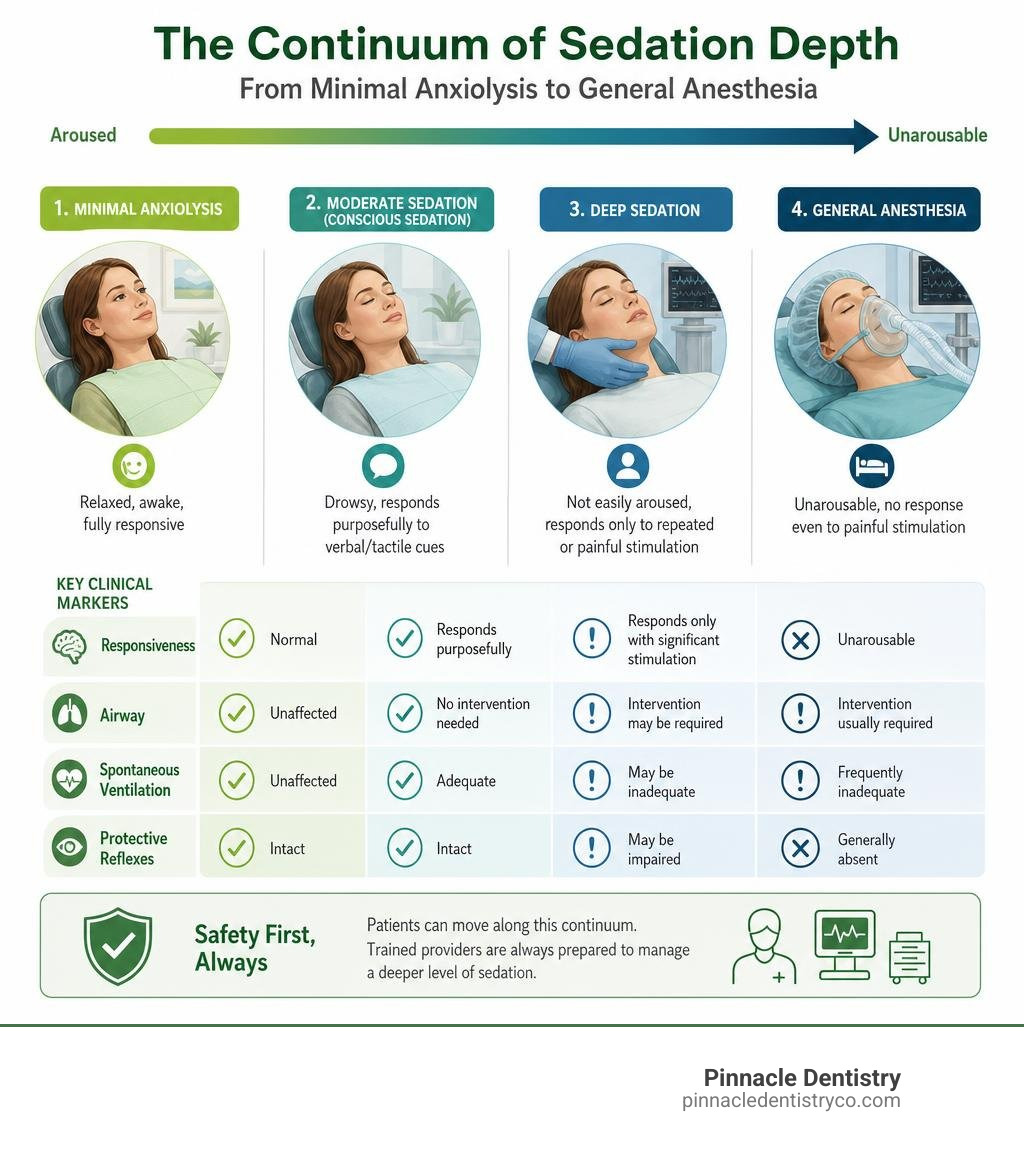
The Continuum of Sedation and Analgesia: From Anxiolysis to General Anesthesia
To understand how providers keep you comfortable, it is helpful to look at sedation not as a series of separate boxes, but as a continuous sliding scale. A patient might start in a very light state of relaxation and gently drift into a slightly deeper state as medications take effect.
Because of this fluid sedation continuum, patient safety depends entirely on the provider’s “rescue capacity.” This means that if a clinician intends to administer moderate sedation but the patient’s body is highly sensitive and drifts into deep sedation, the clinician must have the training, staffing, and equipment to safely manage that deeper level. According to clinical standards detailed in Procedural Sedation – StatPearls, practitioners must always be fully prepared to “rescue” a patient from a level of sedation deeper than originally planned.
Defining the Levels of Sedation and Analgesia
To help clinicians make safe decisions, medical and dental boards define four distinct zones along the sedation spectrum. While sedation relaxes the central nervous system, we often combine it with analgesia, which specifically targets and blocks pain pathways, to provide a completely comfortable experience.
| Sedation Level | Responsiveness | Airway | Spontaneous Ventilation | Cardiovascular Function |
|---|---|---|---|---|
| Minimal Sedation (Anxiolysis) | Normal response to verbal commands | Unaffected | Unaffected | Unaffected |
| Moderate Sedation (Conscious) | Purposeful response to verbal/tactile stimulation | No intervention required | Adequate | Usually maintained |
| Deep Sedation | Purposeful response only to repeated/painful stimulation | Intervention may be required | May be inadequate | Usually maintained |
| General Anesthesia | Unarousable, even with painful stimulation | Intervention often required | Frequently inadequate | May be impaired |
Clinical Decision-Making and Rescue Requirements
In hospital emergency departments and critical care units, clinicians use standardized tools like the Richmond Agitation-Sedation Scale (RASS) to monitor a patient’s exact depth of sedation.
Clinical research shows that maintaining light levels of sedation (specifically a RASS score of 0 to -2, where the patient is calm but easily awoken) in adult ICU patients is associated with shorter ICU lengths of stay and a shorter duration of mechanical ventilation. By keeping sedation as light as safely possible for the required procedure, healthcare providers minimize the risk of complications and support a much faster recovery.
Pre-Procedural Risk Stratification and Patient Assessment
Before a single drop of sedative is administered, a thorough pre-procedural evaluation must take place. This step is the cornerstone of risk mitigation. We sit down with our patients to review their complete medical history, previous experiences with anesthesia, current medications, allergies, and fasting status.

Airway Evaluation and the Mallampati Score
A vital part of the physical exam is evaluating the patient’s airway anatomy. Clinicians look at several physical features to predict how easy or difficult it would be to assist a patient’s breathing if they were to drift into a deeper state of sedation.
- The Mallampati Classification: The patient opens their mouth and protrudes their tongue without saying “ah.” The provider looks at the visibility of the soft palate, tonsils, and uvula. Class I and II indicate a relatively open airway, while Class III and IV suggest a potentially challenging airway.
- Thyromental Distance: Measuring the distance between the tip of the chin and the thyroid cartilage (Adam’s apple). A short distance can indicate a recessed jaw, which makes managing the airway more complex.
- Neck Mobility: Ensuring the patient can comfortably tilt their head back to allow for optimal airway positioning.
ASA Physical Status Classification and Comorbidities
The American Society of Anesthesiologists (ASA) developed a physical status classification system to help clinicians stratify patient risk based on underlying systemic diseases:
- ASA I: A normal, healthy patient.
- ASA II: A patient with mild systemic disease (e.g., well-controlled high blood pressure or mild asthma) without functional limitations.
- ASA III: A patient with severe systemic disease that limits active daily life (e.g., poorly controlled diabetes or stable angina).
- ASA IV: A patient with severe systemic disease that is a constant threat to life.
Understanding these categories is highly important because ASA class 3 to 5 patients have a substantially higher risk of adverse events during procedural sedation compared to healthier ASA class 1 to 2 patients. For patients with higher risk profiles, deciding between oral vs. IV sedation options requires careful clinical judgment to determine the safest route of administration and the appropriate setting.
Essential Monitoring Standards and the Capnography Debate
Continuous patient monitoring is what transforms procedural sedation from a high-stakes guessing game into a highly controlled, safe science. According to the official ADA Guidelines for the Use of Sedation and General Anesthesia by Dentists, providers must monitor consciousness, oxygenation, ventilation, and circulation continuously throughout the procedure.
Standard Vital Signs and Pulse Oximetry
At minimum, a modern clinical setup includes a multi-parameter monitor to track vital signs at regular intervals (typically every 5 minutes):
- Pulse Oximetry (SpO2): Measures the percentage of oxygen in your blood.
- Heart Rate & Electrocardiogram (ECG): Monitors heart rhythm and detects any underlying stress on the cardiovascular system.
- Blood Pressure: Tracked continuously to ensure the patient’s cardiovascular system remains stable.

Waveform Capnography in Procedural Sedation and Analgesia
While pulse oximetry is incredibly valuable, it has a major limitation: it is a lagging indicator of breathing problems. If a patient stops breathing or begins breathing too shallowly, it can take up to several minutes for their blood oxygen levels to drop noticeably on a pulse oximeter, especially if they are receiving supplemental oxygen.
This is where waveform capnography comes in. Capnography measures end-tidal carbon dioxide (EtCO2) in real-time, displaying a visual wave with every single breath the patient takes. If breathing slows down or stops, the capnography monitor alerts the clinical team instantly, long before oxygen saturation levels begin to fall.
Indeed, clinical studies show that moderate sedation is associated with a 17.6-fold increase in the detection of respiratory depression when capnography is used compared to standard pulse oximetry monitoring alone. While some emergency medicine circles debate whether routine capnography leads to unnecessary, minor interventions, there is no denying its safety benefits in preventing significant hypoxic events.
Pharmacological Profiles of Key Sedative and Analgesic Agents
Selecting the right medication requires balancing how quickly a drug starts working (onset), how long it lasts (duration), and how easily it can be adjusted (titration). In modern outpatient settings, sedation dentistry relies on a carefully curated cabinet of medications tailored to each patient’s anxiety and health profile.
Sedative-Hypnotics: Propofol, Etomidate, and Midazolam
- Propofol: An ultra-short-acting drug that is highly popular in hospital settings. It has an incredibly fast onset (about 30 seconds) and wears off within minutes, leaving patients feeling clear-headed. However, it carries a narrow therapeutic window and can cause rapid drops in blood pressure and breathing drive, requiring expert management.
- Etomidate: Known for its exceptional cardiovascular stability, making it a preferred choice for medically fragile or elderly patients. A common side effect is temporary, involuntary muscle twitching (myoclonus).
- Midazolam: A highly reliable benzodiazepine widely used for oral sedation. It provides excellent relaxation, reduces anxiety, and has a strong “amnestic” effect, meaning you likely won’t remember the details of your procedure.
Dissociative Agents and Inhaled Gases: Ketamine and Nitrous Oxide
- Ketamine: This drug induces a unique “dissociative” state. Unlike traditional sedatives, ketamine keeps the patient’s airway reflexes and respiratory drive fully intact while providing exceptional pain relief. It is highly valued in pediatric and emergency care, though adults sometimes experience vivid dreams or mild confusion (emergence reactions) as it wears off.
- Nitrous Oxide: Commonly referred to as laughing gas, this inhaled mixture of nitrous oxide and oxygen is the ultimate flexible sedative. It takes effect in under five minutes and is completely eliminated from the body within minutes of breathing pure oxygen, allowing patients to drive themselves home after their visit.
Complication Management, Rescue Interventions, and Special Populations
Even with the most meticulous preparation, complications can occasionally happen. Safe sedation relies on a clinical team that is fully trained to identify and manage these issues immediately.
Mitigating Respiratory Depression, Hypotension, and Emergence Reactions
The most common complications during sedation are respiratory depression (shallow breathing) and mild hypotension (low blood pressure).
- Airway Rescue: If a patient’s breathing slows, the first step is simple physical stimulation or a gentle “head-tilt/chin-lift” maneuver to open the airway.
- Reversal Agents: If a patient has received an opioid or a benzodiazepine and is breathing too slowly, specific reversal medications are kept immediately at hand. Naloxone is used to reverse opioids, while flumazenil is used to reverse benzodiazepines.
- Aspiration & Laryngospasm: While these sound intimidating, the clinical consensus shows that serious adverse events like aspiration (inhaling fluids into the lungs) and laryngospasm (spasm of the vocal cords) requiring advanced medical intervention are exceptionally rare during standard procedural sedation.
Tailoring Protocols for Pediatric, Geriatric, and Obstetric Patients
Different bodies process medications differently. A safe clinical protocol must always adapt to these unique patient needs:
- Pediatric Patients: Children have higher metabolic rates and smaller, more reactive airways. They often require specialized dosing and close behavioral management.
- Geriatric Patients: Older adults often have a lower physiological reserve and are more sensitive to sedatives. The overall sentinel adverse effect rate (such as temporary hypoxia or low blood pressure) for procedural sedation in elderly patients is 2.6%. To keep them safe, we use a “start low and go slow” dosing strategy.
- Obstetric Patients: For pregnant patients requiring urgent care, we modify positioning (such as a slight left lateral tilt to prevent the baby from pressing on major blood vessels) and select medications that are highly safe for both mother and child.
For many individuals, these customized approaches are what make sedation dentistry for dental anxiety a viable, life-changing option to get the care they need without fear.
Frequently Asked Questions About Sedation and Analgesia
What is the difference between sedation and analgesia?
Sedation targets the central nervous system to reduce anxiety, awareness, and emotional distress, making you feel relaxed or sleepy. Analgesia refers specifically to pain relief and blocks pain signals without necessarily making you sleepy. They are frequently combined to keep you both calm and pain-free.
Why is capnography recommended over pulse oximetry alone?
Pulse oximetry only measures the oxygen saturation of your blood, which can take several minutes to drop if you stop breathing. Capnography measures your exhaled carbon dioxide in real-time with every single breath, identifying shallow breathing or airway obstruction instantly.
What are the fasting guidelines before undergoing moderate sedation?
According to standard medical guidelines, you should fast from solid foods and non-clear liquids (like milk or orange juice) for at least 6 hours prior to elective sedation. Clear liquids (like water or black coffee) are generally permitted up to 2 hours before your appointment to ensure your stomach is completely empty.
How does ketamine preserve airway reflexes during procedural sedation?
Ketamine is a dissociative anesthetic that disconnects the conscious mind from sensory input without shutting down the brainstem. This unique mechanism keeps your natural protective airway reflexes (like swallowing and coughing) and your automatic breathing drive fully active.
What is the role of reversal agents like naloxone and flumazenil?
Reversal agents act as emergency “off switches.” Naloxone rapidly displaces opioids from their receptors to restore normal breathing, while flumazenil does the same for benzodiazepines, quickly waking a patient if they have drifted deeper than intended.
How do age and obesity affect sedation dosing and monitoring?
Older adults and patients with obesity have different medication distribution patterns and lower respiratory reserves. Clinicians calculate medication dosages based on ideal body weight rather than total body weight and maintain a much higher intensity of respiratory monitoring.
Is a dedicated observer required for all procedural sedation cases?
Yes. For moderate and deep sedation, clinical safety guidelines require a dedicated, trained professional whose sole responsibility is to monitor your vital signs, depth of sedation, and breathing, allowing the primary doctor to focus entirely on the procedure.
What are the discharge criteria after receiving outpatient sedation?
Before you can go home, you must meet strict safety criteria: your vital signs must be stable, you must be fully alert, able to walk safely without assistance, and have minimal nausea or pain. You must also have a responsible adult present to drive you home.
Can oral sedation be combined with nitrous oxide safely?
Yes. Combining oral sedative pills with inhaled nitrous oxide is a highly common and effective technique. The nitrous oxide acts synergistically with the oral medication, allowing the dentist to finely tune your level of relaxation throughout the appointment.
What are the long-term risks or side effects of procedural sedation?
For the vast majority of healthy adults, outpatient sedation carries no long-term risks. The most common side effects are temporary, lasting only a few hours after your appointment, and include mild drowsiness, a slight feeling of forgetfulness, or minor nausea.
Conclusion
At Pinnacle Dentistry, we believe that receiving high-quality dental care should never be a source of fear or physical discomfort. By combining advanced clinical protocols with a warm, personalized touch, we ensure that every patient in Colorado Springs, CO, and the surrounding El Paso County, CO area feels completely safe and at ease.
Our team, led by certified MAGD dentists (a rare distinction achieved by fewer than 2% of dentists nationwide), is fully trained in the latest safety standards for sedation and analgesia. Whether you reside in Briargate, CO, or anywhere else in the Pikes Peak region, we are here to provide you with the gentle, stress-free care you deserve.
If you have been putting off dental work due to anxiety, please reach out to us today. We invite you to discover how comfortable your next visit can be by booking a personalized consultation with our experienced team.
