
What a Black Tooth Really Means (And When to Act)
A black tooth can mean several different things depending on its cause. Here is a quick overview:
| Cause | What It Means | Urgent? |
|---|---|---|
| Surface staining (coffee, tobacco, tartar) | External discoloration, often removable | No, but see a dentist |
| Deep decay or cavities | Enamel and dentin breakdown | Yes |
| Pulp necrosis (dead tooth) | Internal tissue has died | Yes |
| Trauma or injury | Internal bleeding inside the tooth | Yes |
| Old amalgam fillings | Metal leaching into tooth structure | Monitor |
| Medications or fluorosis | Staining during tooth development | No, cosmetic concern |
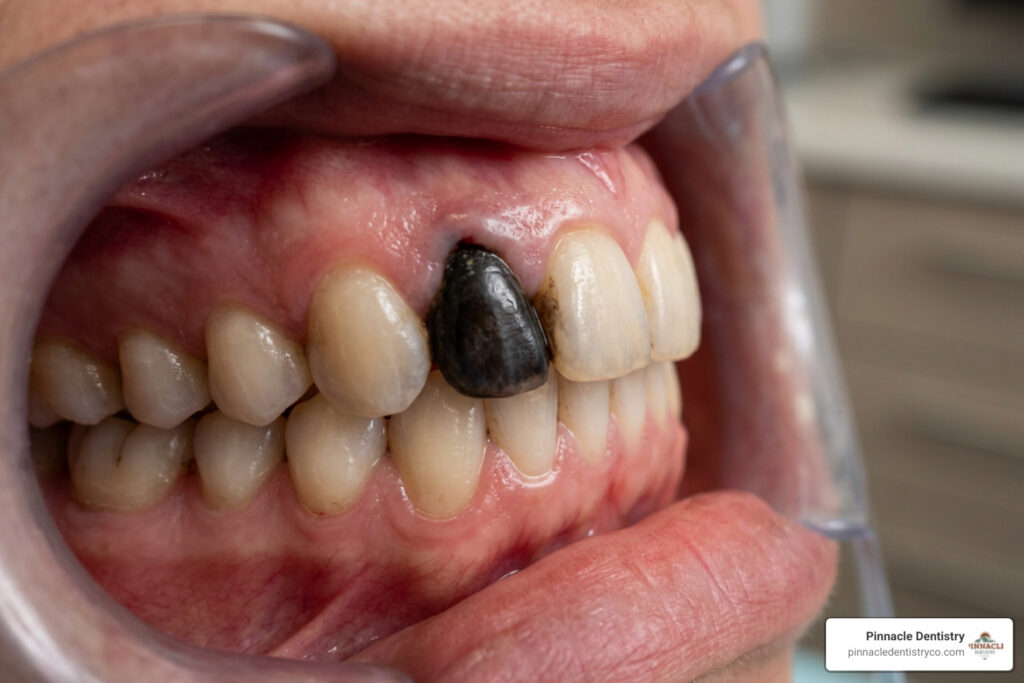
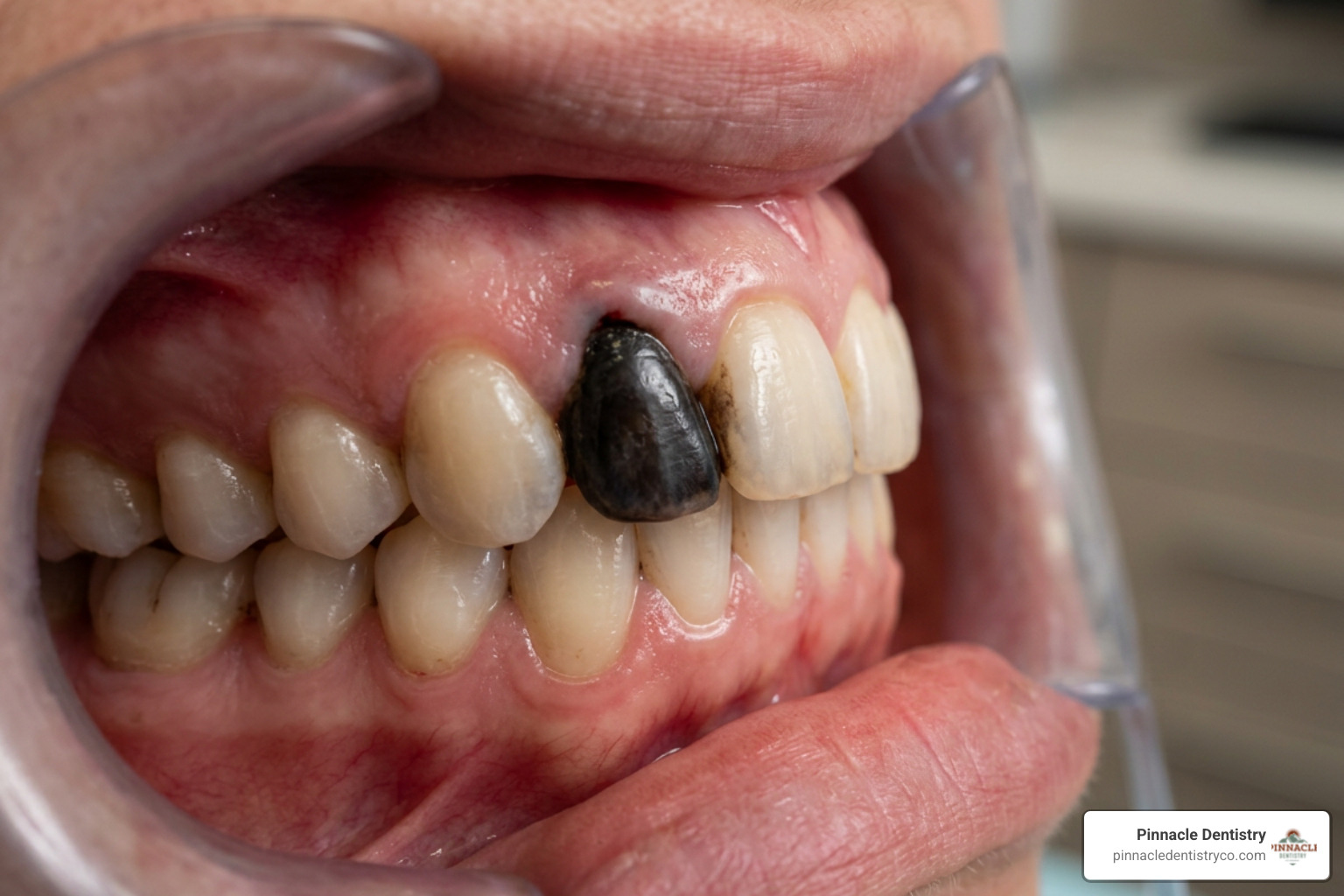
Noticing a dark or discolored tooth can feel alarming, especially when it comes out of nowhere. A black tooth is one of the more common concerns families bring to the dentist, and for good reason. That darkening can signal anything from a harmless surface stain to a seriously compromised tooth that needs immediate care.
What makes it tricky is that a tooth can turn completely black without causing any pain at all. Research shows that up to 25% of traumatized teeth develop discoloration without pain, because the nerve has already died and is no longer sending warning signals. So the absence of pain does not mean the tooth is healthy.
Tooth discoloration affects roughly 15 to 20% of adults, and untreated dental decay remains one of the most common chronic conditions worldwide. Whether the cause is a cavity, an old filling, an injury, or something deeper inside the tooth, understanding what is driving the color change is the first step toward protecting your smile and your health.
I’m Dr. Thomas Jennings, DDS, MAGD, founder of Pinnacle Dentistry in Colorado Springs, CO, and I have spent over 35 years diagnosing and treating black tooth cases ranging from simple staining to advanced pulp necrosis. In this guide, I will walk you through everything you need to know so you can make confident decisions about your family’s dental health.
Clinical Causes of a Black Tooth
When we look at why a tooth darkens, we generally divide the culprits into two categories, extrinsic and intrinsic. Extrinsic factors happen on the outside of the tooth, while intrinsic factors happen deep within the internal structure. Understanding which one you are dealing with is essential for choosing the right path forward.
Extrinsic discoloration is often the easiest to address. This occurs when the outer enamel absorbs pigments from the things we consume. Dark beverages like black coffee, black tea, red wine, and dark sodas are notorious for leaving behind stubborn residue. Using tobacco products, whether smoking or chewing, is another major contributor. Over time, these pigments build up and can make a tooth look dark brown or black.
Another common external cause is tartar, also known as dental calculus. When plaque is not thoroughly brushed away, it mineralizes into a hard deposit. While plaque is mostly invisible, tartar can absorb stains easily and often turns dark brown or black, especially when it forms along the gumline or between the teeth.
Intrinsic discoloration, on the other hand, is a deeper issue. This happens when the inner layer of the tooth, called the dentin, becomes dark. Intrinsic darkening can be caused by certain medications taken during childhood, such as tetracycline antibiotics, or from excess fluoride exposure. However, the most critical intrinsic cause is pulp necrosis, which is the technical term for a dead or dying nerve inside the tooth. When the blood supply to a tooth is cut off due to decay or trauma, the tissue inside begins to break down, releasing dark pigments that stain the dentin from the inside out.
If you suspect your discoloration is more than just a surface stain, it is important to understand the risks of leaving it unaddressed. You can read more about how this impacts your overall well-being in our detailed guide on the emergency alert: what does a black tooth mean for your health?.
How Dental Decay Leads to a Black Tooth
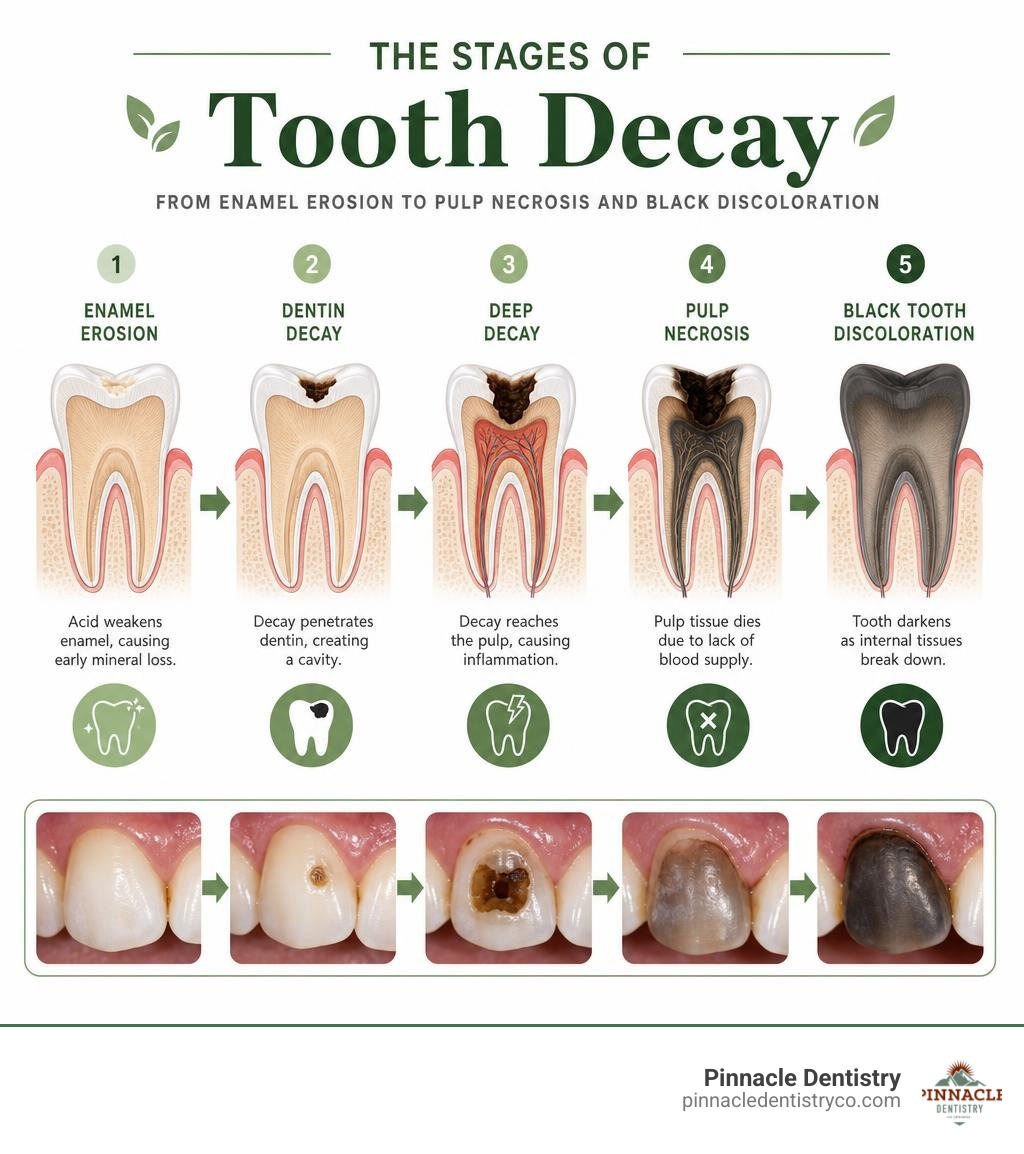
To understand how a simple cavity can eventually turn a tooth black, it helps to look at the anatomy of your teeth. The outer layer is the enamel, which is the hardest substance in the human body. Beneath the enamel lies the dentin, a softer, yellowish layer. At the very center of the tooth is the pulp chamber, which houses the nerves and blood vessels that keep the tooth alive.
Dental decay begins when plaque bacteria feed on the sugars in our food and produce harmful acids. These acids slowly erode the minerals in the protective enamel, creating a small hole or cavity. At first, this decay might look like a chalky white spot or a tiny light-brown speck.
If the cavity is left untreated, the bacteria continue to eat their way through the enamel and enter the dentin. Because dentin is much softer than enamel, decay spreads much faster once it reaches this layer. As the bacteria decompose the tooth structure, the decayed area turns dark brown and eventually black.
If the decay is still ignored, the bacteria will eventually invade the pulp chamber. This triggers an inflammatory response as your body tries to fight off the infection. However, because the pulp is trapped inside a hard, unyielding chamber, the swelling cuts off its own blood supply. This lack of blood flow leads to pulp death, or necrosis. Once the pulp dies, the decomposing tissue releases dark pigments that seep into the surrounding dentin, turning the entire tooth a dark gray, purple, or black color.
To prevent the infection from spreading to your jawbone and surrounding tissues, a specialized procedure is often required. You can learn more about how we save these teeth by reading about what are root canals and how do they work?.
Trauma, Old Restorations, and Internal Bleeding
While decay is a gradual process, dental trauma can cause a tooth to darken much more quickly. A sudden blow to the mouth from a sports injury, a fall, or a car accident can damage the delicate blood vessels inside the pulp chamber.
When a tooth experiences physical trauma, the blood vessels inside can rupture, causing internal bleeding. This process is very similar to how a bruise forms on your skin. The iron-rich red blood cells break down and release pigments into the tiny microscopic tubes within the dentin. Over the course of several weeks or months, the tooth can change color, shifting from a light pink to gray, and eventually to a dark purple or black.
Sometimes, a traumatized tooth can recover, especially in children whose teeth are still developing. However, in many cases, the trauma permanently cuts off the blood supply, leading to a silent pulp death. Because there may not be any pain associated with this gradual transition, many people do not realize anything is wrong until they notice the color change.
Another common reason a tooth might look black is the presence of old dental restorations. Amalgam fillings, which are made of a mixture of metals including silver, tin, and copper, have been used in dentistry for decades. While they are highly durable, the metals in these fillings can slowly corrode and leach into the surrounding porous dentin over time. This can create a dark gray or black shadow beneath the enamel, making the entire tooth look discolored even if there is no active decay.
If you have recently experienced a mouth injury or noticed a sudden color change in a single tooth, it is crucial to have it evaluated by a professional. Discover when you should seek immediate care by checking our list of common signs that you need to see an emergency dentist in Colorado Springs.
Professional Treatments for Darkened Teeth
If you are dealing with a darkened tooth, the good news is that modern dentistry offers several highly effective ways to restore both the health and the appearance of your smile. The right treatment depends entirely on the root cause of the discoloration.
- Professional Dental Cleaning: If the black discoloration is caused by extrinsic stains or a buildup of dark tartar, a professional hygiene visit is often all it takes. Dentists and hygienists use specialized scaling instruments and polishing pastes to gently lift away surface stains and hardened tartar that regular brushing cannot budge.
- Professional Whitening: For intrinsic stains that have not affected the nerve, professional whitening treatments can penetrate the enamel to break up deep-seated pigments. However, standard external whitening will not work on a tooth that has darkened due to pulp necrosis or internal bleeding. In those cases, a technique called internal bleaching can be performed after a root canal, where a whitening agent is placed directly inside the tooth for a short period.
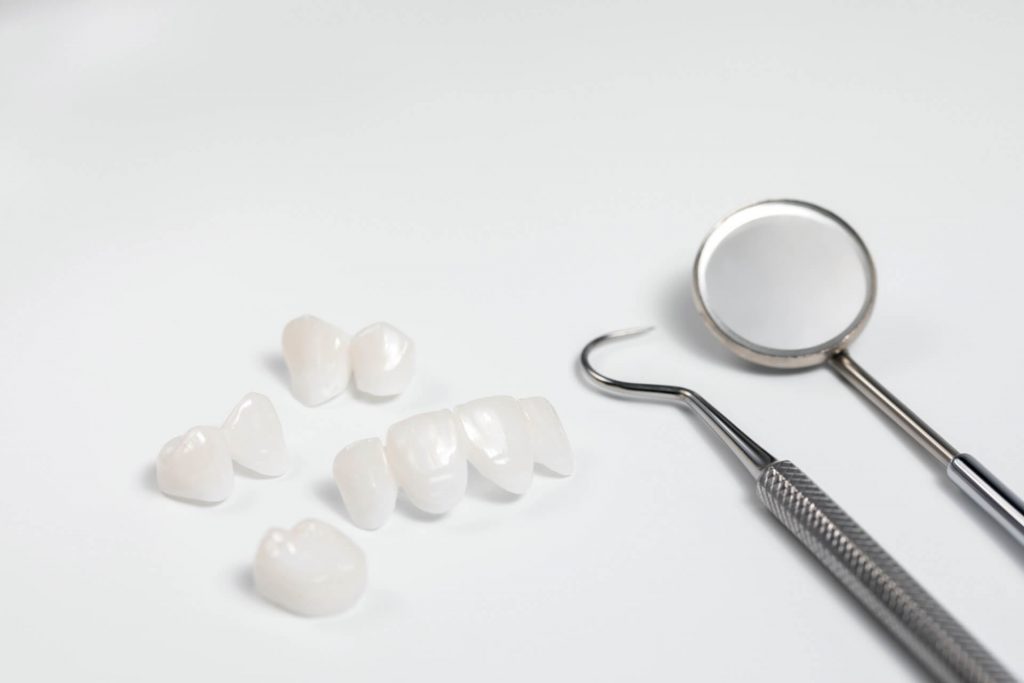
- Dental Crowns and Veneers: When a tooth is severely decayed, structurally weakened, or permanently discolored from old metal fillings, a dental crown is often the best solution. A crown is a custom-made porcelain cap that covers the entire visible portion of the tooth, restoring its natural shape, strength, and color. For cosmetic issues on front teeth, thin porcelain veneers can also be used to mask deep discoloration.
- Root Canal Therapy: If the darkening is due to an infected or necrotic nerve, a root canal is necessary to save the physical structure of the tooth. During this procedure, the damaged pulp is carefully removed, the interior of the tooth is cleaned and sanitized, and the space is filled with a biocompatible material to prevent future infection.
- Tooth Extraction and Replacement: In cases where the decay is too extensive or the tooth has fractured below the gumline, saving it may not be possible. In these situations, we perform a gentle extraction and discuss replacement options like dental implants or bridges to keep your smile complete.
At Pinnacle Dentistry, we specialize in providing personalized, compassionate care to address these issues. You can explore our full range of custom solutions by visiting our page on dental services: restorative dentistry.
Cultural, Historical, and Natural Meanings of Black Teeth
While a black tooth is generally viewed as a health concern that requires treatment in modern Western medicine, the concept of black teeth has a rich and surprising history across different cultures and even in the natural world.
Ohaguro and Traditional Teeth Blackening
For centuries, pitch-black teeth were actually considered a symbol of high social status, maturity, and beauty in several East Asian cultures. The most famous of these traditions is Ohaguro, the Japanese custom of dyeing one’s teeth black.
Practiced from ancient times until it was officially banned in 1870, Ohaguro was popular among married women, samurai, and members of the imperial court. The dye was made by dissolving iron filings in an acidic liquid, like tea or sake, to create a solution called kanemizu. This was then mixed with gallnut powder to create a deep, glossy black lacquer.
Interestingly, Ohaguro was not just cosmetic. The mixture actually acted as a modern dental sealant, coating the teeth and protecting them from cavities and decay. To learn more about this fascinating practice and its social significance, you can read about the history of teeth blackening.
The Legend of the Black Tooth Country
The fascination with black teeth also found its way into ancient geography and folklore. Several classical Chinese texts, including the historic Classic of Mountains and Seas, make reference to a mythical place known as the “Black Tooth Country” (Heichi Guo).
According to these ancient legends, this land was located far to the east of China and was inhabited by people who dyed their teeth black. Some modern historians and researchers believe these mythological accounts may have been inspired by real, early encounters with indigenous cultures in Southeast Asia or the Pacific Islands, where teeth blackening and betel nut chewing were widely practiced. You can dive deeper into these fascinating historical tales by exploring the mythology of the black tooth country.
Phellodon niger: The Black Tooth Mushroom
The term “black tooth” also appears in nature, though it has nothing to do with human dental health. In mycology, Phellodon niger is a unique and distinctive fungus commonly known as the black tooth mushroom.
This unusual woodland species is found in coniferous forests, growing in acidic, mossy soils. It gets its name from the dark, spine-like structures on its underside, which resemble tiny teeth rather than the typical gills found on common mushrooms. The black tooth mushroom is also famous for its tough, woody texture and its ability to absorb and incorporate surrounding forest debris, like pine needles, directly into its cap as it grows.
What is Black Tooth Brewing Company?
If you are searching for the term “black tooth” online, you might also run across a popular regional name in the craft beer scene. Black Tooth Brewing Company is a highly regarded craft brewery named after the iconic Black Tooth Mountain in the Bighorn Mountain range.
Known for its award-winning craft beers, the brewery operates taprooms in Sheridan, Casper, and Cheyenne. They offer a diverse lineup of signature brews, ranging from light, crisp ales to deep, rich stouts. Visitors to their locations can enjoy a lively, family-friendly atmosphere, purchase custom merchandise, and use their online beer finder tool to locate their favorite brews in local stores. While their physical taprooms are located outside of Colorado, craft beer enthusiasts throughout the Rocky Mountain region often keep an eye out for their distinctive cans. You can learn more about their story, hours, and current beer selections by visiting the Black Tooth Brewing Company homepage.
Frequently Asked Questions about Darkened Teeth
Is a black tooth always dead?
No, a black tooth is not always dead. While internal darkening can be a sign of pulp necrosis, a tooth can also turn black due to heavy surface stains from coffee or tobacco, dark tartar buildup, or old silver amalgam fillings leaching into the dentin. A professional evaluation and dental X-ray are required to determine if the nerve is still alive.
Can a black tooth be saved without a root canal?
Yes, depending on the cause. If the dark color is due to external tartar or staining, a professional cleaning can fully restore its appearance. If it is caused by a cavity that has not reached the nerve, a standard dental filling or crown can save the tooth. A root canal is only necessary if the internal pulp tissue is infected or dead.
Why does a tooth turn black without causing any pain?
When a tooth turns black without pain, it usually means the nerve inside the pulp chamber has died completely. Because the dead nerve can no longer send pain signals to your brain, the tooth can decompose silently. However, the lack of pain does not mean the infection is gone; it can still spread to the surrounding bone if left untreated.
Does a black tooth mean there is an active infection?
It often does, especially if the darkening is caused by deep decay or a dead nerve. Even if you do not feel any pain, bacteria can still be active inside the pulp chamber, slowly destroying the tooth structure and posing a risk of forming a painful abscess.
Can a child have a black baby tooth?
Yes. Children often bump or injure their front teeth while playing. This trauma can cause internal bleeding, turning the baby tooth gray or black. While some baby teeth can recover, they should always be checked by a dentist to ensure the developing permanent tooth underneath is not at risk.
How long can you leave a discolored tooth untreated?
You should not leave a discolored tooth untreated. Even if there is no pain, the underlying cause, such as decay or nerve death, will continue to progress. Early intervention is always simpler and more cost-effective than waiting until a major dental emergency arises.
Can professional teeth whitening fix a black tooth?
Professional whitening is highly effective for surface stains, but it cannot fix internal discoloration caused by a dead nerve or old metal fillings. For these issues, restorative treatments like internal bleaching, cosmetic bonding, or a custom porcelain crown are required.
Can bad oral hygiene cause a tooth to turn black?
Yes. Poor brushing and flossing habits allow plaque to build up and mineralize into dark tartar. It also leads to tooth decay, which turns the enamel and dentin dark brown or black as the tooth structure rots.
What is the difference between a black tooth and a black triangle?
A black tooth refers to the discoloration of the tooth structure itself. A “black triangle” is a small, triangular gap that forms between the teeth near the gumline, usually caused by gum recession or bone loss from gum disease.
Is a darkened tooth considered a dental emergency?
If the color change is accompanied by severe pain, facial swelling, fever, or a pimple-like bump on your gums, it is a dental emergency that requires immediate care. If there is no pain, it is not an immediate emergency, but you should still schedule an appointment promptly to prevent complications.
Conclusion
A black tooth is a clear signal from your body that something needs attention, whether it is a simple surface stain or a deeper issue like pulp necrosis. The key to preserving your smile is acting early. With modern preventative care, restorative dentistry, and cosmetic treatments, there is no reason to let a discolored tooth impact your confidence or your health.
At Pinnacle Dentistry, we are proud to offer personalized, high-quality care to families throughout Colorado Springs, CO, and El Paso County, CO. Our team includes certified MAGD dentists, a rare distinction held by less than 2% of general dentists nationwide, ensuring you receive the highest standard of clinical expertise in a warm, welcoming environment.
Whether you need a routine cleaning, a cosmetic consultation, or restorative care, we are here to help you achieve a healthy, beautiful smile. Don’t wait for a minor issue to become a painful emergency. Contact us today or request an appointment at our Briargate office to schedule your consultation with Pinnacle Dentistry.